Pinterest SEO strategy for brands, creators, and agencies
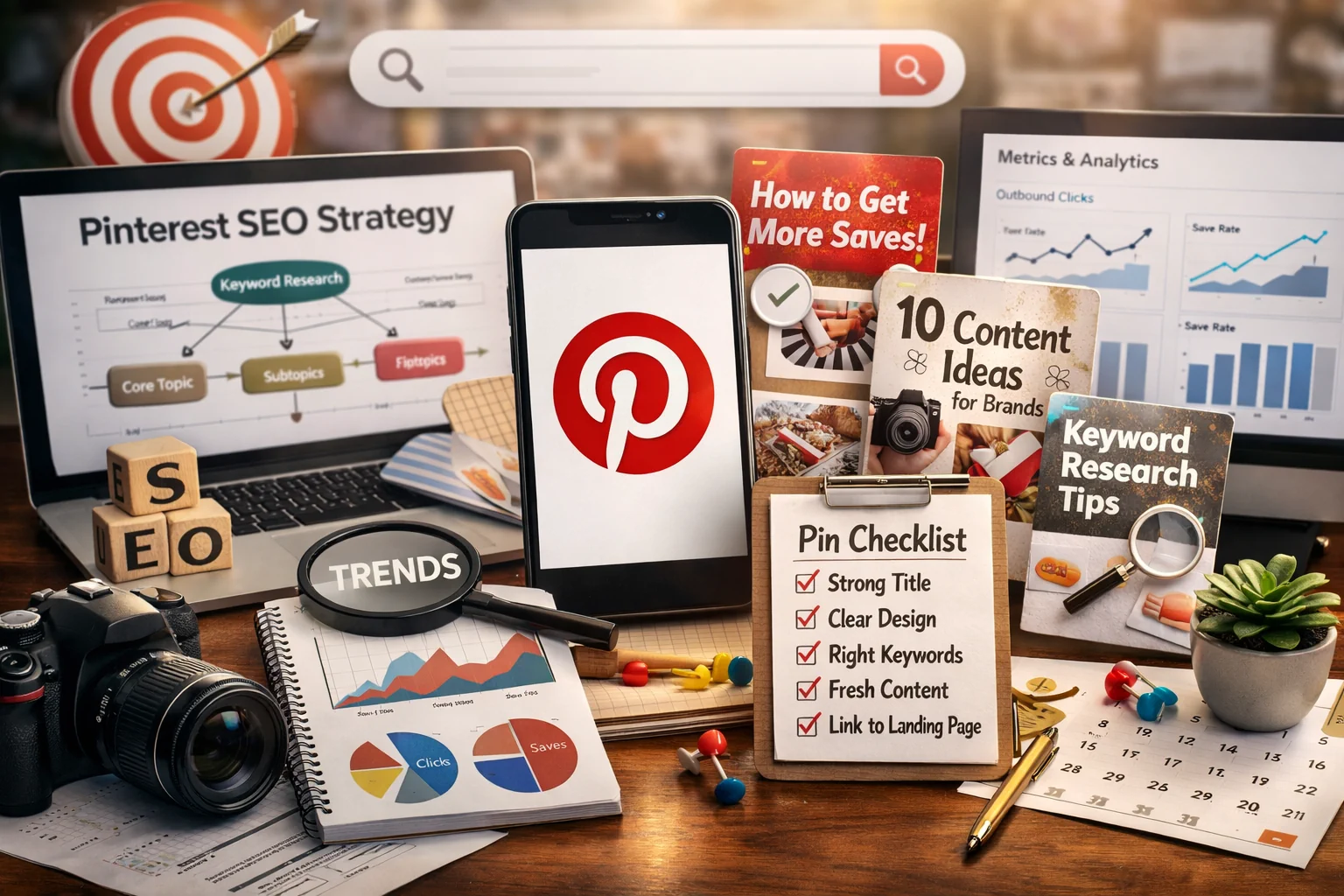
Pinterest is less “social media” and more a visual search and discovery engine. People come to plan, compare, and decide, which makes Pinterest SEO one of the most predictable ways to earn long-tail traffic from evergreen content.
A strong Pinterest SEO strategy isn’t “add more keywords.” It’s a system that connects keyword demand → board structure → Pin packaging → landing page relevance → measurement, and then iterates.
Pinterest SEO for brands: smart strategies that sell
Pinterest SEO for brands works best when it’s built as an evergreen keyword-to-commerce system. Start by mapping keywords to product categories and real use cases (how people search when they’re planning or comparing), then convert those clusters into clean board architecture: one board per intent, plain-language titles, and descriptions that reinforce the cluster naturally. From there, focus on packaging: Pins should have clear text overlays, keyword-led titles, and descriptions with a specific value promise so they earn saves and clicks. Finally, keep website alignment tight—Pins should land on the exact page they promise (a collection, guide, or offer), because mismatched landing pages weaken engagement signals and reduce long-term distribution.
Pinterest SEO for creators: a repeatable engine for evergreen reach
For creators, Pinterest SEO is a compounding distribution channel for content pillars, not a short-term engagement game. Build a keyword map around outcomes your audience wants (ideas, templates, checklists, routines, before-and-after), then structure boards around those pillars so Pinterest can index your work in the right context. Freshness is your advantage: publish consistently and create multiple versions per topic by testing new visuals, new headlines, and different formats (static and short video) while keeping the same intent. Titles and descriptions should be practical and readable—front-load the main keyword, add 1–2 related phrases naturally, and use a soft call to action that matches intent (save, read, try). Over time, strong Pins keep collecting saves and clicks, which improves rankings and sends steady traffic back to your content.
Pinterest SEO for agencies: systems, scale, and predictable outcomes
For agencies, Pinterest SEO scales through a standardized workflow that stays measurable across clients. The foundation is structured onboarding that captures the niche, offers, landing pages, brand voice, constraints, and seasonal priorities, then turns that into a keyword map and board plan with clear clusters. Next comes a reusable creative system: templates, text overlay rules, and a QA checklist so every Pin stays consistent, legible, and aligned with the destination page. Freshness becomes a production pipeline—batch creation, scheduled publishing, and controlled experiments (new images, new headlines, new formats, and keyword variants for the same intent). Reporting should tie back to business outcomes: which clusters drive saves, which Pins generate outbound clicks, which boards act as winners, and which landing pages convert into leads or sales.
How Pinterest discovery works
Pinterest discovery typically comes down to four levers:
- Relevance: how well your Pin matches what someone is searching or interested in
- Quality: how useful and compelling the content is
- Freshness: consistent new content and new versions of content
- Domain reputation: trust signals connected to the website you link to (including steps like claiming your website)
Think of Pinterest SEO as getting these four levers to work together, consistently.
Keyword research that actually maps to Pinterest intent
Pinterest search intent is often “I want ideas I can use,” not “I want a brand.” So your keyword strategy should start with use cases and outcomes.
Where to find keyword demand
- Pinterest Trends: Great for seasonal planning and early-mover content.
- Search suggestions and guides: Type a seed phrase in Pinterest search and collect autocomplete phrases.
- Keyword match type thinking: Even if you’re focused on organic, broad/phrase/exact-match logic helps organize clusters.
Build a keyword map, not a keyword list
Create a simple map with:
- Core topics (top-level categories you want to be known for)
- Subtopics (narrower clusters)
- Formats (guide, checklist, templates, before/after, ideas, how-to)
- Landing pages (where each cluster should send traffic)
Profile and board architecture
Your boards are your information architecture. They tell Pinterest what you’re about and help Pins get indexed in the right context.
Board rules that scale
- One board = one clear keyword cluster (avoid “everything” boards)
- Use board titles that match how people search (plain language beats clever names)
- Write board descriptions that include a few natural phrases from your keyword map
- Keep boards curated (a board full of mixed intent weakens relevance)
Pin packaging checklist
Pinterest can’t rank what it can’t understand. Packaging is how you make your content legible to both users and the algorithm.
Visual format
A practical baseline is a 2:3 aspect ratio (commonly 1000 × 1500 px). Design basics that support SEO outcomes:
- Strong, readable text overlay that states the topic (reinforces relevance)
- Clean layout and clear hierarchy (headline → supporting detail → brand cue)
- Consistent visual system (so people recognize you and save repeatedly)
Title and description
Practical writing rules:
- Front-load the primary keyword in the title
- Use 1–2 secondary phrases in the description, naturally
- Add a clear value promise (what the user gets)
- Use a soft call to action that matches intent (save, read, try, compare)
Pinterest also recommends optimizing titles, descriptions, boards, and URLs with relevant keywords as part of Pin performance and distribution.
Title templates
- “Primary keyword: outcome”
Example: “Pinterest SEO checklist for ecommerce brands” - “How to [do the thing] without [pain]”
Example: “How to plan seasonal Pinterest keywords without guesswork” - “[Number] ideas for [topic]”
Example: “25 content ideas for bridal makeup boards”
Description template (2–3 sentences)
- Sentence 1: what this Pin is and who it’s for
- Sentence 2: what they’ll learn or get
- Sentence 3 (optional): why it works or what to do next
Alt text and accessibility
When available, use alt text to describe what’s in the image in plain language. Treat it like a caption for a human first, then make sure it matches the Pin topic.
Rich Pins and website alignment
If your Pins send traffic to a website, keep the topic alignment tight. A Pin that promises a “template” but lands on a generic homepage will lose performance signals quickly.
If it fits your content, consider Rich Pins so Pins have stronger context and clarity.
Freshness and publishing cadence
Freshness is one of Pinterest’s key discovery levers. The goal is not to spam the same creative, but to publish new Pins and new versions that test different angles:
- New image for the same URL
- New headline for the same topic
- New format (static vs. video) for the same idea
- New keyword variant (same intent, different phrasing)
A simple cadence that works for most teams:
- Brands: 5–15 new Pins per week across collections, evergreen guides, and seasonal pushes
- Creators: 3–7 new Pins per week across 2–4 pillars
- Agencies: Per client, 3–10 new Pins per week, standardized into repeatable batches
Measurement that ties back to SEO decisions
Use analytics to answer SEO questions, not vanity ones. Start with Pinterest Analytics and go deeper with Pin stats when you need performance at the individual Pin level.
Weekly review prompts:
- Which keyword clusters are producing saves (strong relevance)?
- Which Pins drive outbound clicks (strong intent match)?
- Which boards are acting as “winners” (good context)?
- Which landing pages convert (topic match + trust)?
Watch trends across weeks, not days. Pinterest distribution often builds as Pins collect engagement over time.
Advanced tactics that compound results
Seasonal SEO without guessing
Operationally:
- Plan seasonal clusters 6–10 weeks ahead
- Publish early versions first (to earn saves)
- Scale winning topics with more formats and angles
Content repackaging matrix
For each high-value URL or offer, create:
- 3 visual styles (photo, graphic, minimal)
- 3 headline angles (beginner, quick win, myth-busting)
- 2 formats (static + short video)
How Postoria helps you execute Pinterest SEO strategy consistently
In practice, the hardest part of a Pinterest SEO strategy is consistency: publishing fresh Pins on schedule, keeping board strategy organized, and running experiments without losing track of what’s live—especially when you’re managing multiple workspaces and accounts in parallel.
Postoria helps by combining a visual planning workflow (including a unified content calendar) with a dedicated Pinterest post scheduler, plus a Text & Hashtag Library to reuse proven copy, posting groups to streamline multi-account workflows, and analytics for posts published through Postoria.
For deeper execution, you can standardize your seasonal planning with Pinterest seasonal calendars, improve creative packaging with designing Pins that get clicks, and expand keyword coverage with Pinterest SEO long-tail keywords.
Conclusion
Pinterest SEO rewards teams that build a clear keyword-to-board architecture, package Pins for both relevance and readability, publish fresh content consistently, and iterate based on performance signals. If you treat Pinterest like a searchable content system, results build over time: more saves, more rankings, and more evergreen traffic that keeps working long after a Pin is published.