How to build a social media KPI tree from business goals
Most social media reports look detailed, but they do not always explain what to do next.
Reach, impressions, clicks, saves, comments, profile visits, followers, and engagement rate can all be useful. But without a clear business goal, they become a long list of numbers instead of a decision-making tool.
A social media KPI tree fixes that.
It connects business goals, marketing goals, content goals, and post-level metrics so you can stop asking, “Did this post perform well?” and start asking, “Did this post move us closer to the outcome we care about?”
What is a social media KPI tree?
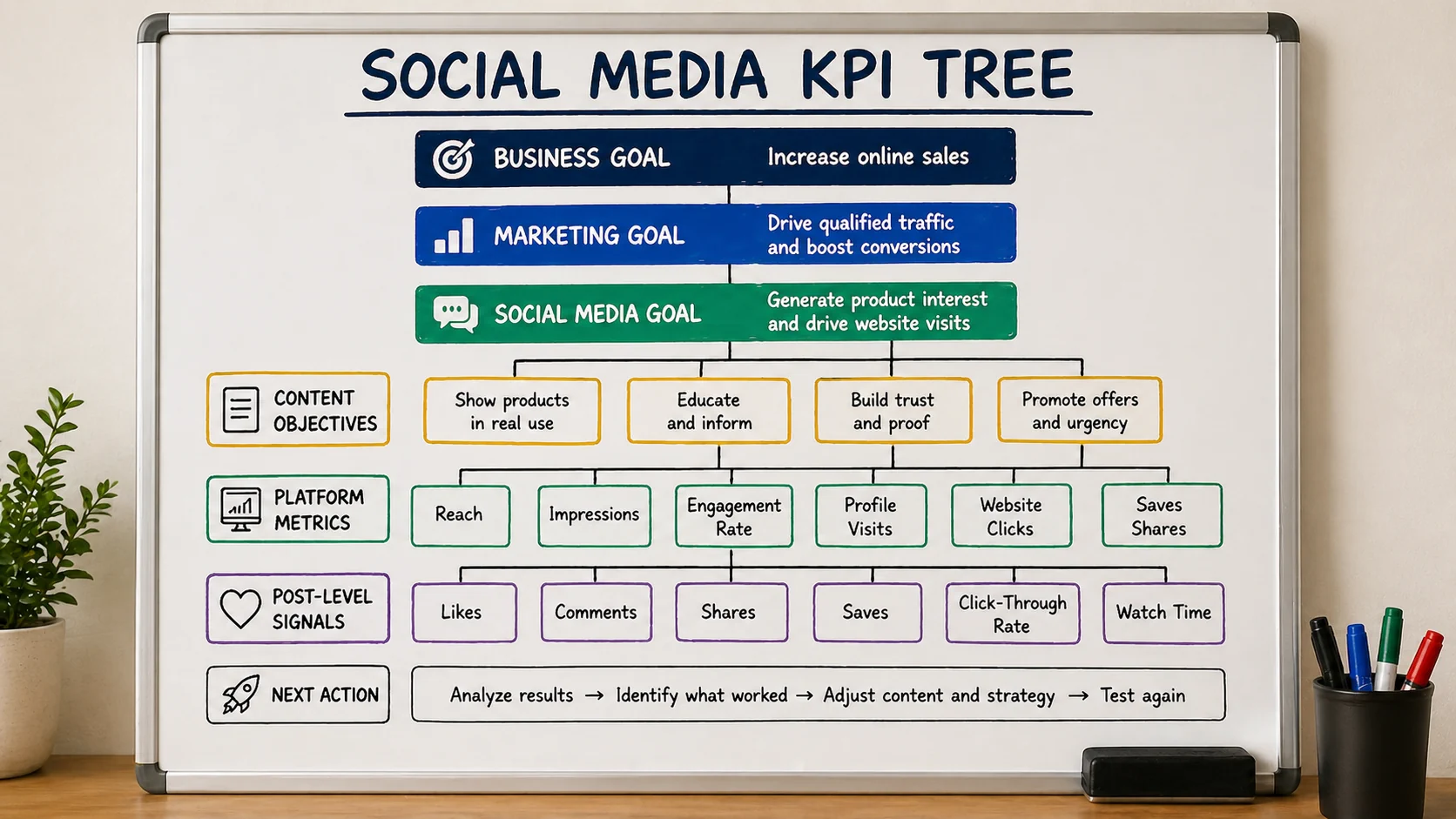
A social media KPI tree is a simple framework that connects your highest-level business goal to the social media metrics that support it.
The structure looks like this:
- Business goal
- Marketing goal
- Social media goal
- Content objective
- Platform metrics
- Post-level signals
- Next action
This hierarchy matters because not every metric has the same job. A post that earns saves may be great for education. A post that earns clicks may be better for conversion. A post that starts replies may be useful for community or trust.
The right KPI depends on the job of the content.
Step 1: choose the business goal
Start with the outcome the business actually cares about.
Examples include:
- Increase sales
- Generate qualified leads
- Drive bookings
- Improve local visibility
- Grow a newsletter
- Support a product launch
- Build founder authority
- Improve customer retention
- Recruit talent
Avoid vague goals like “do better on social media.” They are too broad to guide decisions.
A better goal is:
“Generate more qualified demo requests from B2B founders.”
Or:
“Drive more local appointment bookings for our service business.”
Step 2: translate the business goal into a social media goal
Next, decide what social media can realistically influence.
For example:
Business goal
Increase appointment bookings.
Social media goal
Drive more qualified visitors to the booking page and build trust before they click.
Content objectives
Publish educational posts, proof posts, service explainers, and offer reminders.
Metrics to watch
Profile visits, website clicks, booking page clicks, saves, replies, and post-level engagement.
This translation step keeps you from judging every post by the same metric.
Step 3: choose primary and secondary KPIs
Every goal should have one primary KPI and a few secondary KPIs.
The primary KPI is the main signal. Secondary KPIs help explain what happened.
For example:
Goal: drive website traffic
Primary KPI:
- Link clicks
Secondary KPIs:
- Click-through rate
- Profile visits
- Reach
- Saves
- Comments asking for more information
Goal: build trust
Primary KPI:
- Saves or meaningful comments
Secondary KPIs:
- Shares
- Profile visits
- Watch time
- Replies
- Direct messages
Goal: increase awareness
Primary KPI:
- Reach
Secondary KPIs:
- Impressions
- Follower growth
- Shares
- Video views
- Branded searches, if tracked elsewhere
Goal: support conversions
Primary KPI:
- Leads, purchases, bookings, or demo requests from tracked links
Secondary KPIs:
- Link clicks
- CTA clicks
- Profile actions
- Comments with buying intent
- Direct messages
The secondary metrics help you understand why the primary KPI moved.
Example KPI tree for e-commerce
A simple e-commerce KPI tree could look like this:
Business goal
Sell more seasonal products.
Marketing goal
Drive qualified traffic to product pages.
Social media goal
Increase product discovery and purchase intent.
Content objectives
- Show products in real use
- Explain benefits
- Answer buying objections
- Promote limited-time offers
- Share customer photos with permission
Primary KPIs
- Product page clicks
- Purchases from tracked links, when available
Secondary KPIs
- Saves
- Shares
- Comments about sizing, price, availability, or shipping
- Profile visits
- Engagement on product posts
Next actions
If product posts get saves but few clicks, test stronger CTAs. If clicks happen but purchases do not, review the landing page, offer, or product page clarity.
Example KPI tree for service businesses
A local or service-based business may use this tree:
Business goal
Increase consultations or appointments.
Marketing goal
Build trust and reduce booking hesitation.
Social media goal
Educate potential customers and drive booking actions.
Content objectives
- Answer common questions
- Show proof
- Explain the process
- Introduce the team
- Promote availability
Primary KPIs
- Booking page clicks
- Calls or direction requests, when tracked through the platform
Secondary KPIs
- Profile visits
- Saves
- Comments with questions
- Direct messages
- Google Business Profile actions
Next actions
If educational posts get strong engagement but no booking actions, add clearer CTAs. If proof posts drive profile visits, create more before-and-after, testimonial, or process content.
Example KPI tree for SaaS
A SaaS company may need a tree like this:
Business goal
Generate qualified signups or trials.
Marketing goal
Increase problem awareness and product consideration.
Social media goal
Turn useful content into website visits and product interest.
Content objectives
- Teach workflows
- Compare approaches
- Show product use cases
- Share customer problems
- Promote feature-led solutions
Primary KPIs
- Trial signups
- Demo requests
- Website clicks from social
Secondary KPIs
- Saves
- Shares
- Comments from target users
- Profile visits
- Engagement on product workflow posts
Next actions
If educational posts perform well but product posts do not, connect the product more directly to the problem explained in the educational content.
Example KPI tree for creators
A creator may use social media to grow an audience and monetize later.
Business goal
Grow owned audience and product sales.
Marketing goal
Move followers toward email, community, or digital product offers.
Social media goal
Build trust and drive newsletter or product clicks.
Content objectives
- Teach useful ideas
- Share personal perspective
- Create repeatable series
- Promote lead magnets
- Launch products or services
Primary KPIs
- Newsletter signups
- Product clicks
- Community joins
Secondary KPIs
- Saves
- Shares
- Comments
- Follower growth
- Profile visits
Next actions
If posts earn followers but no email signups, improve the profile CTA and add more bridge content between free advice and the offer.
How to use a KPI tree in your content calendar
A KPI tree becomes most useful when it is connected to your planning process.
For each planned post, add:
- Goal
- Content pillar
- Primary KPI
- CTA
- Link or conversion path
- Review date
This helps you avoid publishing posts with unclear purpose.
For example, a post can be labeled:
- Goal: drive traffic
- Pillar: education
- Primary KPI: link clicks
- CTA: read the guide
- Review date: next Monday
That makes performance easier to interpret later.
How Postoria fits into the workflow
Postoria helps you keep the KPI tree connected to your actual content workflow.
You can use the visual calendar to plan posts around clear goals, such as awareness, traffic, trust, or conversions. Then, after publishing, Postoria’s analytics help you review how those posts performed across supported platforms from one place.
A simple workflow could look like this:
- Assign each post a goal before scheduling it.
- Use clear campaign names or content labels.
- Review the primary KPI after publishing.
- Compare results by goal, not just by platform.
- Use the results to decide what to publish next.
This keeps analytics close to planning. Instead of treating reporting as a separate task, you can use Postoria to connect content ideas, scheduled posts, performance data, and next actions in one workflow.
Common KPI tree mistakes
Avoid these mistakes when building your KPI tree:
- Using too many primary KPIs
- Judging awareness posts by conversion metrics only
- Treating all engagement as equal
- Ignoring comments and replies because they are harder to quantify
- Reporting metrics without recommended actions
- Comparing platforms without considering different audience behavior
- Changing goals every week before learning anything
A KPI tree should simplify decision-making, not add more reporting work.
Conclusion
A social media KPI tree helps you connect content to business outcomes. Start with the business goal, translate it into a social media goal, choose primary and secondary metrics, and use the results to plan the next round of content.
When every post has a clear job, analytics is easier to interpret and your content calendar is easier to refine.