Car OS Media turns one car photo into a published campaign
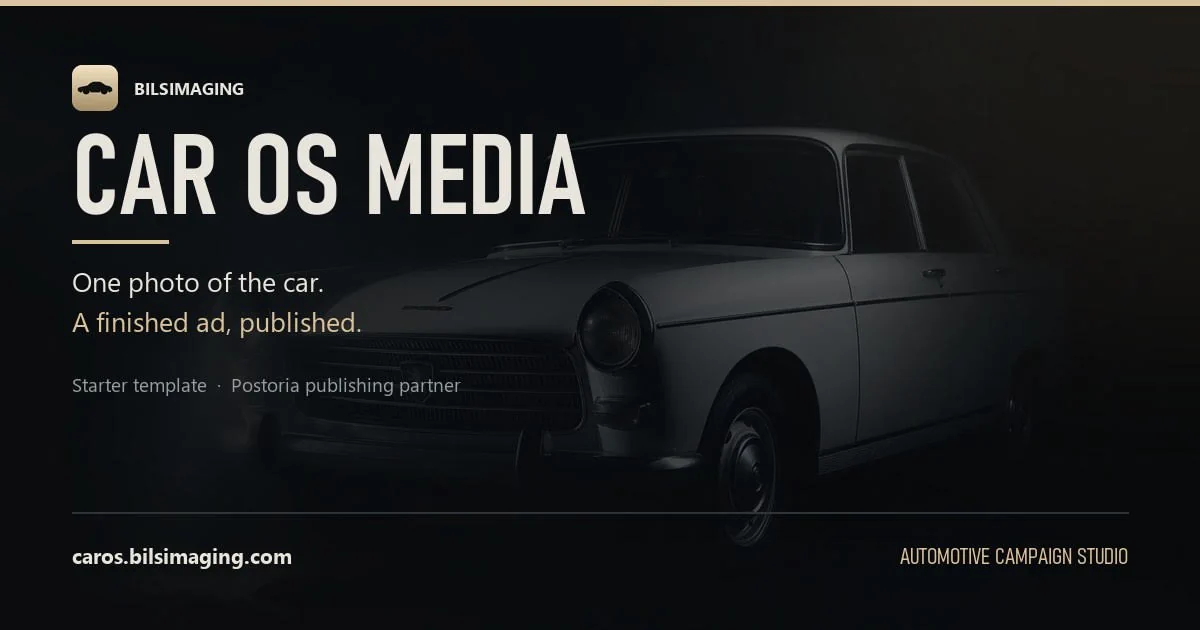
One photograph of a car can now become a directed, reviewed, and published campaign without moving files manually between a collection of creative and social media tools.
Car OS Media is a free n8n workflow created by bilsimaging. It turns a car photo and a short creative brief into campaign strategy, hero frames, an optional short film with native audio, social copy, and a Postoria publication.
The workflow combines OpenAI GPT-5.4, GPT Image 2, LTX 2.3, Telegram, fal.ai, n8n Data Tables, and the verified Postoria community node. It is available from the n8n workflow library.
From one photo to a complete campaign
Car OS Media starts in Telegram. The user sends a car photo, opens a creative brief, and selects the campaign objective, aspect ratio, film length, tone, and language.
The workflow then coordinates five creative roles:
- A creative director orchestrates the campaign
- A brand strategist defines the audience, angle, hook, proof points, and call to action
- An automotive art director writes the visual direction and image prompts
- A cinematic motion director storyboards each video beat and its audio
- A social copy chief prepares captions, hashtags, and the first comment
The result is a structured campaign blueprint rather than a single unreviewed prompt response. Car OS Media includes eight automotive campaign angles, from a hero launch or luxury lifestyle treatment to vehicle transformation, stock drop, interior technology, and seasonal preparation.
Human approval before the expensive steps
The workflow has two approval checkpoints.
First, it presents the campaign hook, audience insight, creative angle, identity description, and estimated model spend. The user can approve the direction, steer it with additional notes, or decline it before any images are generated.
Second, it presents the generated hero frames. The user can approve them for animation, refine one or more frames, publish a still instead of producing a film, or cancel the campaign.
This structure keeps a person in control of the creative direction and prevents video rendering from starting until the selected frames have been reviewed.
Keeping the vehicle consistent
Automotive creative is especially sensitive to small visual changes. A different wheel design, paint finish, light signature, body line, or badge can make an otherwise polished image unusable.
Car OS Media addresses this with an identity lock. The art direction records only visible characteristics of the source vehicle, and the workflow prepends the same identity block to each generation request. Every hero frame is edited from the original photo instead of from the previously generated frame, reducing cumulative drift between scenes.
When a frame is refined, the workflow sends both the frame being corrected and the original photo as an identity reference.
GPT Image 2 for frames and LTX 2.3 for motion
The approved beat plan is turned into hero frames with openai/gpt-image-2/edit. Each frame can be reviewed in Telegram as it is completed.
For a film, each approved frame becomes a five-second video beat through fal-ai/ltx-2.3-quality/image-to-video. LTX generates native audio for each beat, and the completed beats are assembled into one film. If an individual beat fails, the workflow can continue with the successful beats instead of losing the whole campaign.
Users who only need a static campaign can skip the motion stage and send an approved frame directly to the publishing console.
Postoria handles the distribution layer
The final stage uses the official Postoria n8n node end to end. The workflow does not need individual social network credentials or custom publishing requests inside n8n.
It uses Postoria to:
- Find the correct Postoria workspace.
- Retrieve the connected social accounts.
- Import the finished image or video and wait until it is ready.
- Publish immediately or schedule the campaign.
- Record the Postoria post and media IDs for reporting.
The account list is loaded on every run, so the workflow is not tied to hardcoded social account IDs. It also removes unsupported destinations before creating the post: YouTube is skipped for still images, while Google Business Profile is skipped for films.
Postoria receives one caption for the selected accounts. Car OS Media chooses the prepared caption that fits the strictest character limit in the destination set rather than silently truncating a longer version.
An operations loop, not just a generation demo
Car OS Media stores campaign sessions and publication records in two n8n Data Tables. A separate daily trigger combines those records with recent Postoria posts and sends an operations digest to Telegram.
The report covers throughput, estimated model spend, campaign mix, and the stages where work is stopping. It deliberately avoids inventing engagement metrics that are not present in the workflow data.
This makes the template useful as a starting point for an agency or automotive content team, not only as a one-off AI generation demonstration.
What to know before running it
The imported workflow includes its own guided setup. In summary, it requires:
- An n8n instance reachable over public HTTPS, because Telegram approvals resume through webhooks
- Telegram, OpenAI, fal.ai, ImgBB, and Postoria credentials
- Two n8n Data Tables for campaign sessions and publication records
- A Postoria Pro or Agency plan with at least one connected social account
By default, the source photo is rehosted temporarily on ImgBB so the rendering service can reach it. The upload expires after seven days, and a cancelled campaign returns the deletion link for earlier removal. Because ImgBB is a public third-party host, agencies working with client vehicles, readable number plates, or sensitive backgrounds should replace that step with controlled HTTPS storage when required by their privacy policy.
Model availability and pricing can change, so the cost estimates included in the template should be treated as guidance rather than a guaranteed price. Teams should also review the disclosure requirements for AI-generated content on every destination network; the workflow should not be assumed to add an AI disclosure automatically.
Try Car OS Media
You can open the project site for an overview or get the free workflow from n8n.
Car OS Media was designed and built by bilsimaging. Postoria reviewed the integration path and is featuring the project as a practical example of what teams can build with the verified Postoria node. For installation and credential setup, see How to use the Postoria n8n integration.