Google Business Profile discovery algorithms
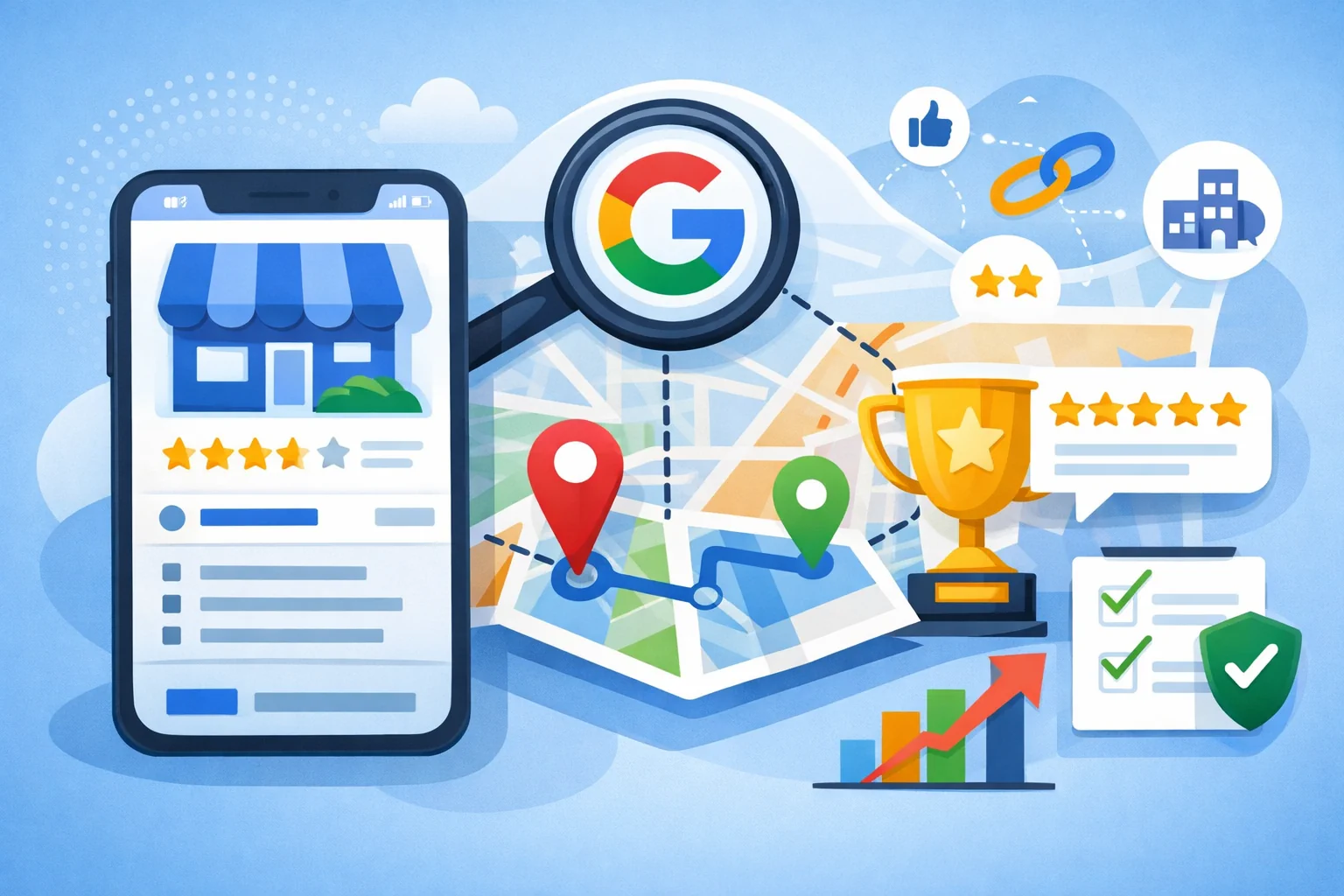
Google Business Profile visibility is not controlled by one public algorithm that businesses can reverse-engineer. Google does not publish a simple ranking formula for local results. What it does publish is more useful: the main systems that influence whether a business appears in Search and Maps for a local query.
Google’s official local ranking guidance says local results are based primarily on relevance, distance, and prominence. In practice, those three pillars interact with profile quality, reviews, content freshness, and the broader trust signals around the business.
This guide explains the main discovery systems in plain English and shows what a real business can do to improve visibility without chasing myths.
The local discovery model: five systems to understand
Think of Google Business Profile discovery as five overlapping systems.
| System | What it answers | What businesses can improve |
|---|---|---|
| Relevance | Does this profile match the search? | Categories, services, description, products, posts, photos, and clear wording |
| Distance | Is this business near the searcher or target area? | Accurate address, service area, hours, and location data |
| Prominence | Is this business well known and trusted? | Reviews, links, mentions, citations, and offline reputation |
| Review trust | Do customers describe real, useful experiences? | Review volume, recency, quality, and professional responses |
| Profile quality | Is the profile complete, accurate, and policy-safe? | Verification, current details, compliant content, and regular maintenance |
None of these systems works alone. A nearby business can lose visibility if its profile is incomplete. A prominent business can still struggle for a specific search if its categories and services do not match the query.
1. Relevance: how well your profile matches the search
Relevance is the match between what someone searches and what your Business Profile clearly says you offer.
For example, a dental clinic that wants to appear for “emergency dentist near me” needs more than a generic category. Its profile should make emergency dental care easy to understand through the primary category, services, business description, website page, photos, and posts.
Improve relevance by checking these elements:
- Choose the most accurate primary category.
- Add specific services instead of broad labels only.
- Use customer language in your description and posts.
- Keep product, service, and appointment details current.
- Publish updates that reinforce what the business actually offers.
Do not stuff keywords into the business name or description. The goal is not to repeat a phrase unnaturally. The goal is to make the profile complete enough that Google and customers understand what the business does.
2. Distance: how location affects local visibility
Distance is the hardest pillar to influence because it depends on where the searcher is and where the business is located. Google says distance considers how far each potential search result is from the location term used in a search, or from what Google knows about the user’s location when no location is specified.
A home cleaning company cannot optimize its way into every nearby city if it does not actually serve those areas. But it can reduce confusion by making its real service area accurate.
Check these details:
- The address is correct for storefront businesses.
- Service areas reflect where the business actually operates.
- Hours match real availability.
- Holiday hours are updated before customers rely on them.
- Location pages on the website match the Business Profile information.
Distance is not a loophole. It is a relevance and usefulness signal for local customers.
3. Prominence: how known and trusted the business appears
Prominence is about how well known the business is. Google notes that prominence can be influenced by information it has about a business from across the web, including links, articles, directories, and reviews.
A boutique hotel with strong reviews, local press mentions, travel directory listings, and consistent brand references has more prominence signals than a similar hotel with almost no web presence.
Ways to build prominence over time:
- Earn links from local organizations, event pages, partners, and media.
- Keep directory listings accurate and consistent.
- Encourage real customers to leave honest reviews.
- Publish useful local content on the website.
- Keep social and website profiles consistent with the Business Profile.
Prominence is slow-building. It rewards businesses that look real, active, and trusted across more than one place.
4. Review trust: why review quality matters more than perfection
Reviews influence both ranking and customer decisions. Google states that more reviews and positive ratings can improve local ranking, but its review policy also makes it clear that fake, incentivized, or manipulated reviews are not allowed.
A strong review profile is not only a high star rating. It is a steady pattern of real customer experiences.
Review trust improves when:
- Reviews mention specific services, staff, problems solved, or outcomes.
- The review flow is steady instead of suspiciously spiky.
- The business responds professionally to positive and negative reviews.
- Negative reviews are handled with clarity instead of defensiveness.
- The business never offers incentives in exchange for reviews.
For a local restaurant, a review that says “great place” is nice. A review that mentions the brunch menu, patio seating, quick service, and parking is more useful to future customers and easier for Google to interpret.
5. Profile quality: complete, current, and compliant information
Google says businesses with complete and accurate information are more likely to show up in local search results. A neglected profile creates uncertainty for both customers and search systems.
Profile quality includes:
- Verified ownership.
- Accurate phone number, website, address, hours, and services.
- Fresh photos that represent the actual location or work.
- Posts that are current and not misleading.
- Offers and events that are removed or updated when they expire.
- Policy-compliant content and business information.
Google’s Business Profile performance documentation also notes that verified profiles can access performance data, which helps owners understand how people find and interact with the profile.
What to do this week
Use this quick checklist to tighten your Google Business Profile without turning it into a major project.
1. Fix the foundation
Check your business name, category, address, phone number, website, hours, service area, services, and appointment links. Correct anything outdated.
2. Improve relevance
Clean up your services, products, business description, and photos. Use real customer language, not generic marketing phrases.
3. Review your review process
Create a simple, policy-safe review request process. Ask customers after a real service experience. Do not offer discounts, gifts, or rewards in exchange for reviews.
4. Publish a helpful update
Post something timely and specific: a seasonal offer, booking reminder, new service, event, or frequently asked question. The Google Business Profile posting strategy explains how to choose posts that support calls, bookings, and visits.
5. Connect GBP to your broader local marketing
Make sure your Business Profile matches your website and social presence. The Google Business Profile SEO guide can help you connect posts, reviews, photos, and tracking into one local visibility workflow.
Where Postoria fits
Postoria helps businesses schedule Google Business Profile posts alongside Facebook, Instagram, LinkedIn, and other channels. That matters because local updates are easy to forget when they are managed separately.
For example, a dental clinic can prepare a monthly calendar with appointment reminders, holiday hours, new-service announcements, and patient education posts. A local restaurant can schedule menu updates, weekend events, catering reminders, and seasonal offers. Postoria keeps those updates visible in one calendar instead of relying on someone to remember them manually.
Conclusion
Google Business Profile discovery is shaped by relevance, distance, prominence, reviews, and profile quality. You cannot control every ranking factor, and you should not chase shortcuts. You can control how complete, accurate, helpful, and consistent your profile is.
Start there. Make the business easy to understand, keep information current, earn real reviews, and publish useful updates. Those fundamentals are what make a Business Profile more trustworthy for both customers and local search.