How to use top-post analysis to plan next month’s content
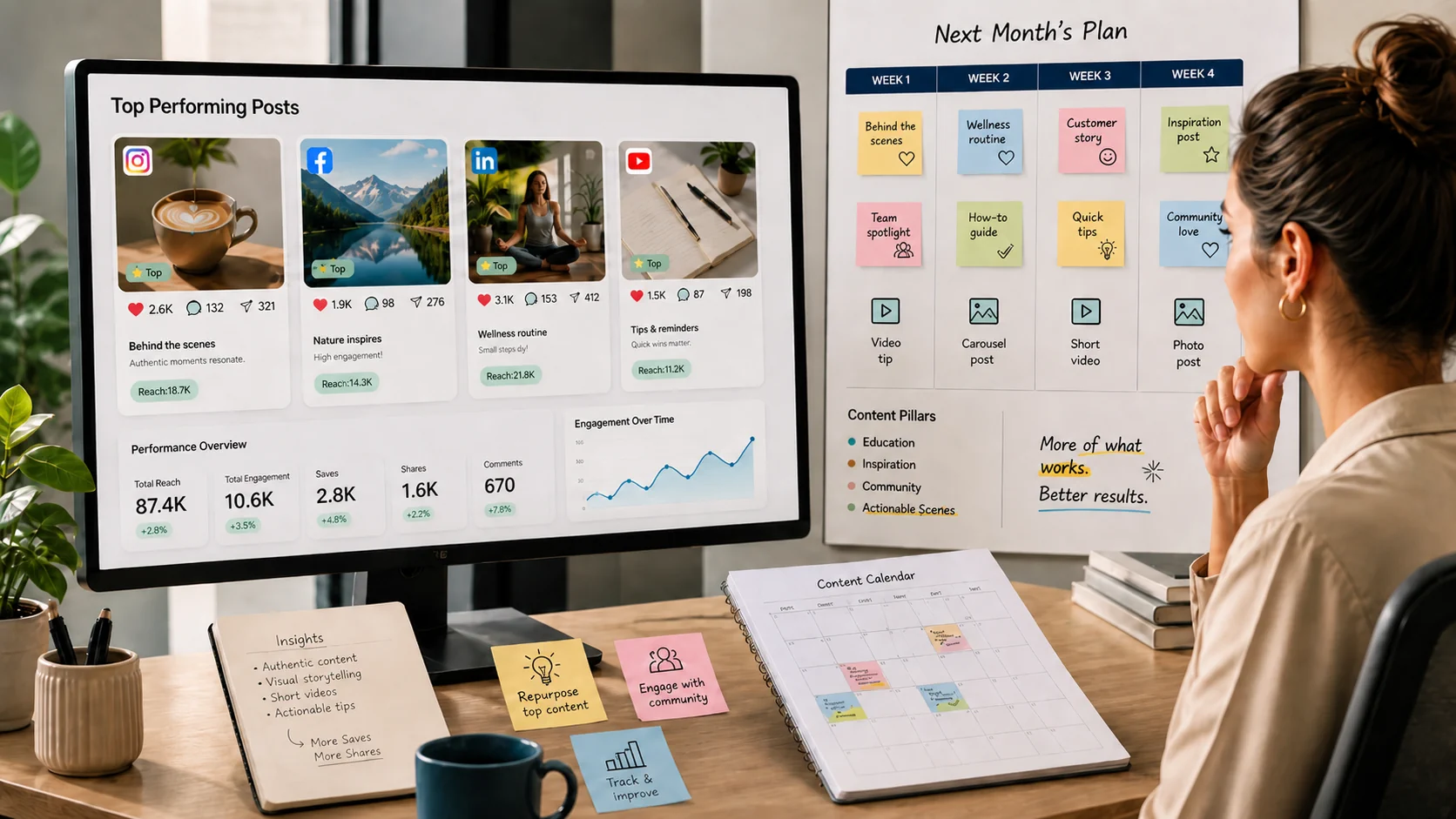
Your top posts are more than a highlight reel. They are clues.
They show what your audience noticed, saved, shared, clicked, questioned, or trusted. If you review them properly, they can help you plan next month’s content with less guesswork.
The mistake many teams make is looking at the top posts, saying “that did well,” and then moving on. A better approach is to turn top-post analysis into a repeatable planning workflow.
Choose the right top posts
Do not rank posts only by likes.
Choose top posts based on the goal you care about. A post that supports awareness may not be the same as a post that supports trust, traffic, or sales conversations.
For awareness, review posts with the highest reach, views, and profile visits.
For engagement, look at posts with the most comments, replies, saves, and shares.
For traffic, focus on posts that drove the most link clicks or website visits.
For trust, review posts that created strong comments, direct messages, saves, and shares.
For sales support, look at posts that led to inquiries, bookings, demo requests, or product interest.
For community, focus on posts that created meaningful conversations.
If possible, select the top 10 posts for the month across your key platforms. If you have a smaller account, review the top five.
Create a top-post teardown system
For each top post, record the same details so you can compare posts fairly.
Start with the basics:
- Platform: where the post was published
- Date: when it went live
- Format: video, carousel, image, text, link, or update
- Content pillar: education, proof, product, trust, community, or timely content
Then capture the creative and strategic details:
- Hook: the opening line, frame, or idea
- Promise: what the post helped the audience understand or do
- CTA: what action the post asked for
- Visual style: screenshot, face-to-camera video, product photo, graphic, or text-only post
Finally, record what you learned:
- Result: the metric that made it a top post
- Comment insight: what people asked, repeated, or reacted to
- Next idea: how you can use the insight next month
This turns performance into planning material instead of just a report.
Look for patterns, not isolated wins
One strong post can be luck. Three strong posts with the same pattern are a signal.
Look for patterns in:
- Topics
- Hooks
- Formats
- Visual styles
- Post length
- CTA style
- Platform fit
- Audience objections
- Questions in the comments
- Timing
- Content pillar
For example, you may discover that mistake-based hooks drive comments, checklists earn saves, founder stories work on LinkedIn, or product demos create more qualified clicks than static announcements.
The goal is not just to know which post won. The goal is to understand why it worked.
Separate repeatable ideas from one-time moments
Some top posts work because of timing.
That might include:
- A news event
- A seasonal trend
- A product launch
- A limited-time offer
- A timely customer question
These posts can be useful, but they may not be easy to repeat.
Other top posts work because the structure is repeatable.
That might include:
- A checklist
- A myth vs. reality post
- A before-and-after example
- A customer question answered
- A short tutorial
- A comparison
- A common mistake
Repeatable structures are more useful for planning. You can reuse the format without copying the same post.
Turn top posts into next-month experiments
Do not simply repost your winners. Build experiments from them.
For each top post, ask:
- What can we repeat?
- What should we change?
- What new angle should we test?
- Which platform deserves a version of this?
- What deeper article, video, or carousel could this become?
- What customer question does this reveal?
Here are a few ways to turn insights into experiments:
- If a checklist post earned many saves, create a three-part checklist series.
- If a founder story got strong comments, publish one behind-the-scenes lesson each week.
- If a product demo drove clicks, test a shorter demo with a clearer CTA.
- If a customer FAQ got shared, build a recurring “question of the week” post.
- If a carousel worked on Instagram, adapt it into a LinkedIn version.
The goal is to scale the lesson, not duplicate the exact post.
Build a top-post content map
Once you know what worked, map those insights into your next calendar.
Use four simple buckets.
Repeat
These are formats or topics that clearly worked and can be used again.
For example, if tutorial carousels earned strong saves for three weeks in a row, add more tutorial content to next month’s calendar.
Refresh
These are posts that worked but need a new hook, example, visual, or CTA.
For example, a post about common mistakes may become a new version with a sharper opening line or a more specific audience angle.
Expand
These are short posts that deserve a deeper version.
A strong short post could become:
- A video
- A blog article
- A carousel
- A guide
- A newsletter section
- A product education post
Retire
These are ideas that performed well once but are not worth repeating, or formats that no longer support your goals.
Not every winner deserves a sequel. Some posts work because of timing, novelty, or context.
Use audience comments as planning fuel
The comments under top posts are often more valuable than the metrics.
Look for:
- Questions people ask repeatedly
- Objections they mention
- Words they use to describe the problem
- Examples they request
- Misunderstandings you need to clarify
- Positive reactions to specific phrases or formats
Turn a question into a tutorial. Turn an objection into a comparison post. Turn a misunderstanding into a myth-busting post.
Audience language can also help you write stronger hooks because it shows how people naturally talk about the problem.
Connect top posts to business goals
A post can perform well and still not support your business.
Before turning a top post into next month’s content, ask:
- Did this post attract the right audience?
- Did it support a product, service, campaign, or trust goal?
- Did it create useful engagement or only surface-level reactions?
- Did it lead to traffic, inquiries, saves, or conversations?
- Does it fit the brand we want to build?
This protects your content strategy from chasing attention that does not help the business.
A funny post may get reach. A controversial post may get comments. A trending format may get quick engagement. But if the content does not support the audience, brand, or business goal you care about, it should not control your next calendar.
Review before planning the next calendar
Top-post analysis should happen before the next calendar is finalized.
A simple monthly rhythm can look like this:
- Pull the top posts from each key platform.
- Group them by goal and content pillar.
- Fill out the teardown notes for each post.
- Identify three to five patterns.
- Choose next-month experiments.
- Add those experiments to the calendar.
- Schedule and measure again.
This keeps your content process connected to real audience behavior.
With Postoria, you can keep scheduling and analytics close together, making it easier to turn performance review into the next month’s publishing plan.
Conclusion
Top-post analysis is one of the easiest ways to make next month’s content smarter. Your best posts show what your audience values, but only if you slow down and study why they worked.
Review your top posts by goal, look for repeatable patterns, turn comments into ideas, and build the next calendar around evidence instead of guesswork.