Unified content strategy: How Instagram, YouTube, LinkedIn, and Google Business work together
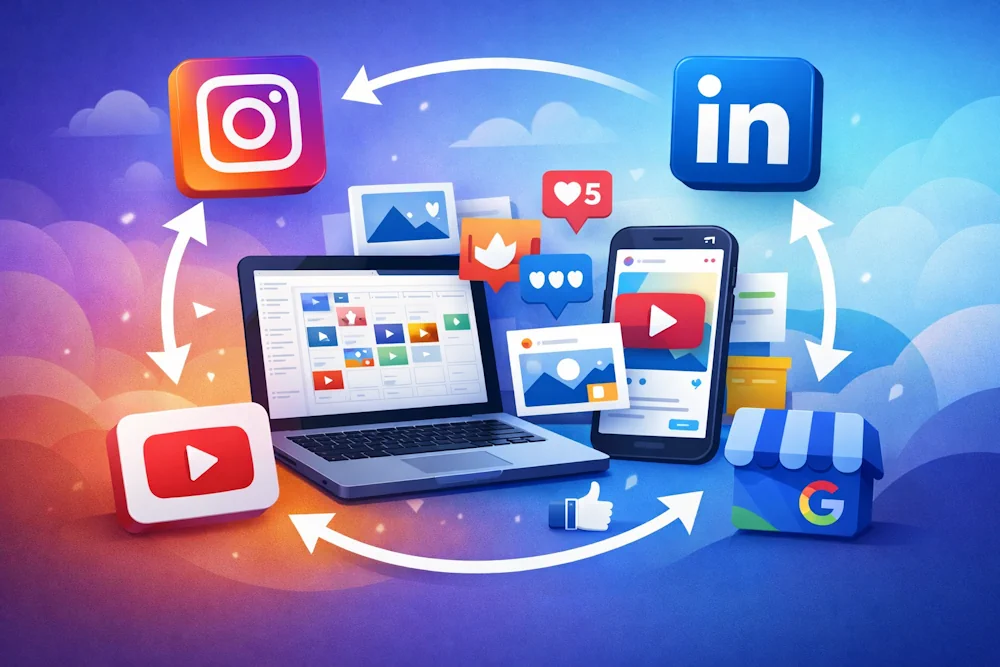
A unified content strategy does not mean posting the same thing everywhere. It means every platform has a clear job, every post supports the same business goals, and your team can plan the system without starting from zero each day.
Instagram, YouTube, LinkedIn, and Google Business Profile can work together extremely well because they serve different stages of attention. Instagram can create familiarity. YouTube can build depth and search visibility. LinkedIn can establish credibility with professional audiences. Google Business Profile can help local customers take action when they are already searching.
The challenge is coordination. Without a shared plan, each channel becomes a separate to-do list. This guide shows how to connect the platforms into one practical strategy.
What a unified content strategy is
A unified content strategy is a shared system for planning, adapting, publishing, and measuring content across multiple channels.
It usually includes:
- One set of business goals
- A small number of content pillars
- Platform-specific roles
- A shared publishing calendar
- Clear repurposing rules
- Consistent messaging and visual identity
- Analytics that connect content to outcomes
It is different from simple cross-posting. Cross-posting says, “Put this post everywhere.” Unified strategy says, “Use this idea differently on each platform so it does the right job.”
Give each platform a specific job
Before planning posts, decide what each platform is responsible for.
Instagram: familiarity and visual proof
Instagram is strong for visual storytelling, product moments, social proof, short videos, carousels, behind-the-scenes content, and community touchpoints. It helps people recognize the brand and understand its personality.
Good Instagram roles include:
- Show product or service in context
- Share quick tips and visual explainers
- Turn customer questions into short posts
- Use Stories for reminders, polls, and retention
- Build trust through behind-the-scenes content
If Instagram is one of your core channels, connect your strategy with practical discoverability work such as Instagram SEO and consistent publishing rules.
YouTube: depth, search, and education
YouTube is where you can go deeper. It is useful for tutorials, case studies, product walkthroughs, comparisons, webinars, and Shorts that introduce people to longer-form topics.
Good YouTube roles include:
- Answer high-intent search questions
- Explain complex topics clearly
- Host customer stories and demos
- Turn one pillar topic into several clips
- Build playlists around recurring themes
Use a dedicated YouTube SEO strategy so videos are not only published but also packaged for search, retention, and long-term discovery.
LinkedIn: credibility and professional trust
LinkedIn is especially useful for B2B, founders, agencies, consultants, recruiters, and companies that sell through expertise. It is not only a place for announcements. It is a place to explain how you think.
Good LinkedIn roles include:
- Share expert commentary
- Publish lessons from campaigns or customer work
- Build employee advocacy
- Explain frameworks and decision criteria
- Start conversations with buyers, partners, and peers
If LinkedIn is a priority, combine company-page content with personal profiles and a clear LinkedIn SEO workflow so your positioning is easy to understand.
Google Business Profile: local trust and action
Google Business Profile is different from a social feed. People often see it when they are close to taking action: calling, getting directions, reading reviews, comparing local options, or checking updates.
Good Google Business Profile roles include:
- Publish offers, updates, events, and service reminders
- Add recent photos and useful product/service visuals
- Support local SEO with complete, accurate information
- Build trust through reviews and responses
- Turn local search attention into calls, visits, bookings, or website clicks
For local businesses, pair social content with a Google Business Profile SEO guide so local visibility and content planning support each other.
Build the strategy around content pillars
Content pillars keep multi-platform publishing from becoming random. Choose 4-6 pillars that connect to your business goals and audience questions.
Example pillars for a service business:
- Customer problems and how to solve them
- Before-and-after examples
- Educational tips
- Team expertise
- Local proof and community involvement
- Offers, events, and seasonal reminders
Example pillars for a SaaS company:
- Workflow education
- Product use cases
- Customer stories
- Industry commentary
- Comparison and decision support
- Behind-the-scenes product updates
Each platform can express the same pillar differently. A “customer questions” pillar might become a YouTube tutorial, an Instagram carousel, a LinkedIn insight post, and a Google Business Profile update.
Use a hub-and-spoke workflow
The easiest way to unify content is to choose one hub asset, then create smaller platform-specific spokes.
A hub asset could be:
- A YouTube video
- A blog post
- A webinar
- A case study
- A product launch
- A customer story
- A seasonal campaign
Then turn it into channel-specific content:
- Instagram: carousel, Reel, Story sequence, product image, or FAQ post
- YouTube: long-form video, Shorts, playlist addition, or demo clip
- LinkedIn: expert post, founder commentary, document post, or employee advocacy prompt
- Google Business Profile: update, offer, event, photo post, or service reminder
This approach saves time because the idea is shared, but the execution is adapted.
Example: one campaign across four channels
Imagine a local fitness studio launching a six-week beginner program.
YouTube
Publish a video: “What to expect in your first six weeks of beginner strength training.” Add chapters for equipment, schedule, common fears, and results to expect.
Create a carousel with “5 things beginners worry about before joining a gym.” Use Stories to answer questions and share behind-the-scenes clips from the studio.
Post from the founder about how the program was designed for busy professionals and why consistency matters more than intensity at the start.
Google Business Profile
Publish an offer or update with the start date, booking link, location details, and a photo of the studio.
The message is consistent, but the format changes based on the platform’s job.
Plan with a monthly content map
A unified strategy becomes easier when the month is planned as a map, not a pile of posts.
For each week, define:
- Main theme
- Hub asset
- Supporting channels
- Primary call to action
- Owner
- Publish dates
- Success metric
For example:
- Week 1: Educational theme, YouTube tutorial, LinkedIn summary, Instagram carousel, metric: saves and watch time
- Week 2: Proof theme, customer story, Instagram Reel, GBP update, metric: profile actions and inquiries
- Week 3: Decision theme, comparison post, YouTube Short, LinkedIn post, metric: clicks and qualified conversations
- Week 4: Retention theme, FAQ content, Stories, GBP photo/update, metric: replies, bookings, and repeat visits
If you need a lighter planning process, start with a weekly social media calendar and expand it into a monthly system once the workflow is stable.
Avoid these common mistakes
Unified strategy breaks when teams confuse consistency with sameness.
Watch out for these mistakes:
- Posting identical copy everywhere. Adapt the hook, length, visual, and CTA to the channel.
- Letting every channel chase a different goal. Keep the business goal shared.
- Using YouTube only for uploads. Plan promotion clips and follow-up posts before publishing.
- Ignoring Google Business Profile. Local customers may find your business there before they see your Instagram.
- Measuring each platform in isolation. Look at how channels assist each other.
- Creating too many content pillars. More pillars create more confusion.
- Skipping ownership. Every post needs an owner and a deadline.
Measure the system, not just individual posts
A unified strategy should be measured at two levels.
First, measure platform performance:
- Instagram: saves, shares, profile visits, replies, reach, and engagement quality
- YouTube: impressions, click-through rate, retention, watch time, subscribers, and assisted conversions
- LinkedIn: comments, profile visits, followers, website clicks, and qualified conversations
- Google Business Profile: calls, website clicks, directions, bookings, photo views, and review activity
Second, measure the system:
- Did the campaign stay on schedule?
- Did one asset create useful content for several channels?
- Did the content answer real customer questions?
- Did the same message show up clearly across platforms?
- Did the team learn what to repeat next month?
Use this with a broader social media KPI tree so every metric has a reason to exist.
How Postoria helps run a unified strategy
A unified strategy is hard to maintain when every platform has its own calendar, files, captions, and approval process.
Postoria gives teams one place to plan, schedule, and review social content with a visual calendar, publishing tools, analytics, media library, workspaces, posting groups, Teams, bulk upload, AI captions, and automations on paid plans. It supports major platforms including Instagram, YouTube, LinkedIn, Google Business Profile, Facebook, Threads, Pinterest, TikTok, Telegram, Bluesky, Tumblr, and X.
For teams managing several channels, the value is simple: one shared plan, fewer scattered tabs, and a clearer view of what is going live.
You can also use Postoria’s post-across-platforms workflow to plan one campaign and adapt it for each channel without losing the overall strategy.
Unified content strategy checklist
Use this checklist before your next campaign:
- Business goal is clear.
- Each platform has a defined job.
- Content pillars are limited to 4-6 themes.
- One hub asset is chosen for the campaign.
- Each platform has a customized version of the idea.
- Calls to action match the channel and funnel stage.
- Assets are stored in one place.
- Posts are scheduled before the campaign starts.
- Analytics are reviewed after the campaign ends.
- Learnings are turned into the next content plan.
Conclusion
A unified content strategy makes social media easier to manage because each channel has a purpose. Instagram builds familiarity. YouTube adds depth. LinkedIn builds professional trust. Google Business Profile turns local intent into action.
Do not try to make every platform identical. Start with one shared goal, a small set of content pillars, and a monthly plan that adapts each idea to the channel. When your platforms work together, your content becomes more useful for customers and much easier for your team to execute.