Your competitors are getting recommended by AI. Why isn't your business?
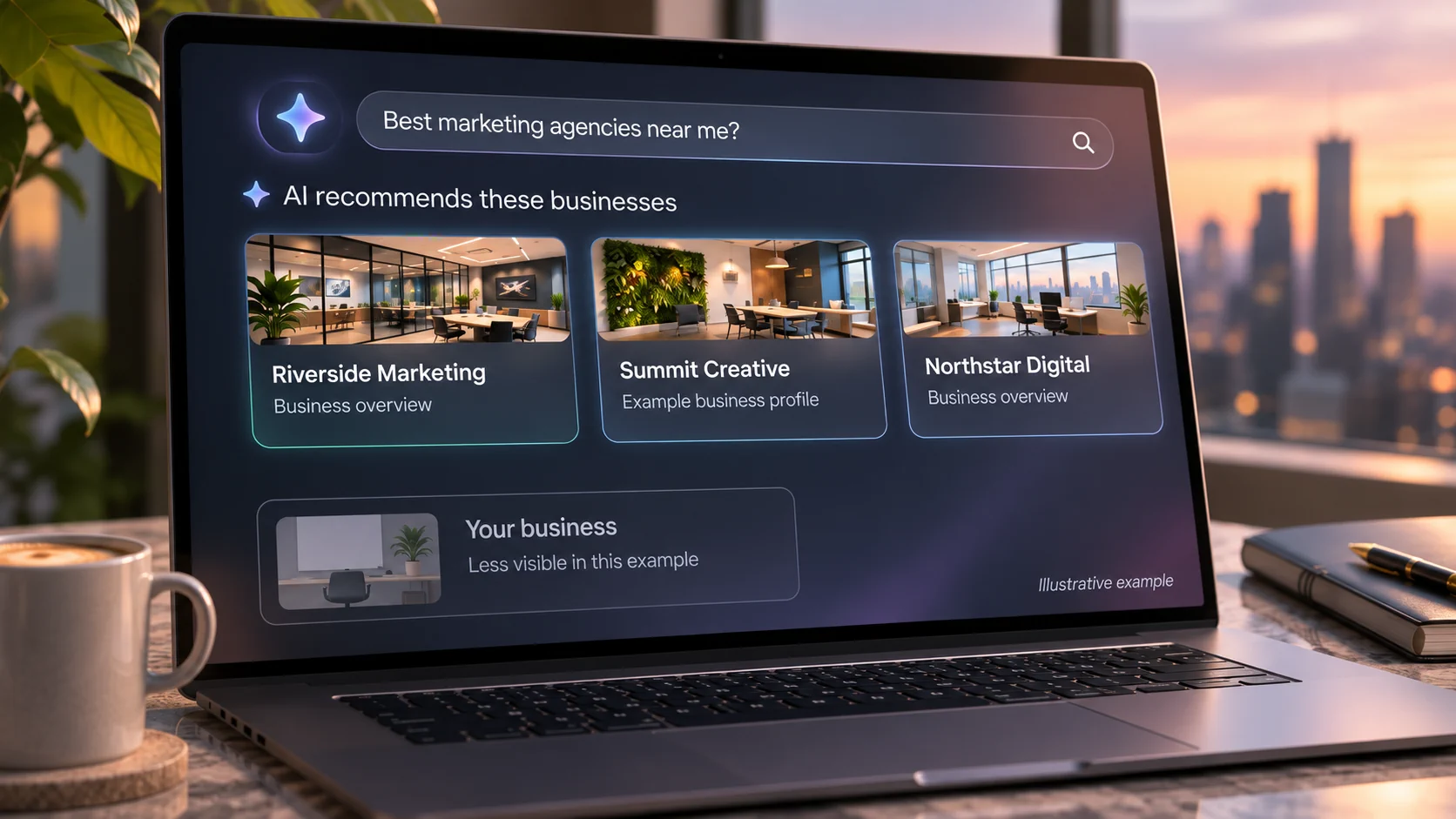
A potential customer asks an AI assistant to recommend a business like yours. The answer includes two competitors and a company you have never heard of. Your business is missing.
It is tempting to assume you need a new AI marketing trick. But the more useful question is simpler: Can a stranger quickly find reliable information that explains what you do, who you help, and why your business is relevant?
AI-powered search can bring together information from different sources. The answers vary by question, location, available evidence, and the system being used. There is no guaranteed way to earn a recommendation. However, you can make the information people need more accurate, accessible, and useful.
Why AI might recommend your competitors instead
If a competitor appears in an AI answer and your business does not, several explanations are worth investigating:
- A better match for the question. The competitor may describe the exact service, specialty, or location the customer asked about more clearly. Your business might offer the same thing, but its public pages may not make that obvious.
- Pages that are easier to discover. A competitor’s relevant pages may be accessible to the search services or crawlers used to find information, while yours could be blocked, missing from search results, or difficult to read.
- More complete, consistent business details. The competitor may provide clearer service descriptions, locations, hours, or buying information across its website and public listings, giving customers and search tools more context.
- More relevant independent mentions. Reviews, directories, articles, or other third-party sources may discuss the competitor in connection with the customer’s particular need. Such mentions can provide useful context, depending on which sources the AI system uses.
These are hypotheses to check, not confirmed explanations for any particular recommendation. AI systems differ in how they find and use sources, and one answer cannot reveal their exact reasoning. Compare the information available about each business before deciding what needs improvement.
Here is where to start.
Test what potential customers actually ask
Do not begin by asking an AI assistant, “What do you know about my brand?” Customers who have never heard of you will not search that way.
Instead, try questions based on real buying decisions. A bicycle repair shop, for example, might test:
- “Where can I get a commuter bike repaired in [city]?”
- “Which bike shops explain repair costs before starting work?”
- “How do I choose a shop for brake and gear repairs?”
Try several variations across a couple of AI search experiences. Record which businesses appear, what sources are linked, and whether any important information is wrong.
Treat this as a small discovery audit, not a scientific ranking. An answer may change even when your website has not. A missing mention is a reason to investigate, not proof that your business has been penalized.
Make your business easy to describe
Many company websites sound polished but leave basic questions unanswered.
Consider the difference:
Vague: “We deliver innovative solutions with a customer-first approach.”
Useful: “We repair commuter and road bikes in Austin. Customers can book tune-ups, brake adjustments, and flat-tire repairs, with an estimate before work begins.”
The second version gives a visitor concrete information. It identifies the service, location, audience, and booking expectation without claiming to be the best in town.
Review your homepage and main service pages. Can someone find the following in under a minute?
- What you sell or provide
- Who the service is for
- Which locations you serve, if location matters
- What a customer receives and what it may cost
- How to ask a question, book, or buy
Put important answers in readable text, not only inside an image, video, or downloadable brochure. Use specific language that matches your real offering rather than adding every popular keyword you can think of. If your social profiles also need clearer messaging, our social media brand promotion strategy guide offers a practical next step.
Answer the questions that influence a recommendation
A general description tells people what your business is. Helpful answers show whether it fits their situation.
Imagine a customer looking for a bookkeeping service. They may want to know whether you work with freelancers, what records are needed, whether you handle monthly reporting, and how onboarding works.
Create short, accurate pages or sections that answer those questions. A useful structure is:
- State the question in familiar language.
- Give a direct answer in the first paragraph.
- Explain any limits, costs, or conditions that affect the decision.
- Show a genuine example of the process where possible.
- Offer a relevant next step.
Do not publish dozens of nearly identical AI-written pages. One clear, original explanation based on how your business actually works is more valuable to customers than a large collection of vague promises.
Check the information outside your website
Customers can encounter your business through maps, directories, social profiles, customer reviews, and independent publications. These sources may also be useful references in search experiences, although you cannot control which ones a particular AI system uses.
Look for inconsistencies in your public information. Does one profile show an old address? Does a directory list a service you stopped offering? Are your opening hours different on two platforms?
For a local business, keeping your Google Business Profile accurate is a sensible first step. Update service descriptions and business details where they are actually managed. Do not assume that publishing a social post changes your official business listing. Our guide to Google Business Profile and social media explains what each channel contributes.
Independent evidence matters too. A detailed customer review, a genuine project example, or an accurate mention in a relevant publication may help prospective buyers evaluate you. Ask for honest reviews without scripting the outcome, and never invent testimonials or partnerships. If you have a genuinely useful resource to offer independent publishers, our guide to earning backlinks with AI explains how to research relevant opportunities.
Make sure search services can access your content
Even excellent information is less useful if search services cannot reach it.
Google says its AI search features rely on established search fundamentals: accessible pages, clear content, and helpful information. It does not require special AI-only markup to qualify for AI Overviews or AI Mode. See Google’s guidance for AI features.
ChatGPT search uses a crawler called OAI-SearchBot to help surface websites in search results. It is separate from GPTBot, which is associated with model training. A website owner can manage these settings independently. See the official OpenAI crawler documentation.
If you manage your website yourself, review its indexing settings and make sure important pages are publicly accessible. Otherwise, ask your website manager to check them. Allowing access does not guarantee that an AI service will recommend or even mention your business.
Try a realistic 30-day visibility plan
You do not need to rebuild your marketing strategy in one week. Focus on the biggest information gaps first.
Week 1: Find the missing answers. Test a handful of customer-style AI questions. Read your website as a first-time visitor would. List missing or outdated information.
Week 2: Fix the essentials. Improve your main service description, contact information, and two frequently asked questions. Make sure the claims match what your business can deliver.
Week 3: Check public profiles. Review business listings and social profiles. Request honest feedback from customers where appropriate. Correct outdated information at its source.
Week 4: Publish useful explanations. Turn three common customer questions into website content or social posts. Recheck the original AI questions, noting any changes without assuming the new content caused them.
The point of this month-long plan is to close information gaps, not to manufacture popularity.
Measure progress without chasing a single AI mention
Keep a simple record of what changes after you improve your information:
- Are people reaching the relevant service pages through search?
- Are inquiries more specific because customers understand your offering?
- Are customers finding accurate hours, location details, and contact information?
- When someone discovers your business, can they explain where they first heard about it?
You can also review a consistent set of AI-search questions periodically. Consider mentions and citations a directional observation, not a guaranteed or complete visibility score.
Keep your business information and expertise visible across social media with Postoria
Correct business information and helpful website pages are the foundation. Social media can reinforce that work by showing potential customers what your expertise looks like in practice. A bike shop, for example, might share a maintenance tip on Facebook, a workshop demonstration on Instagram, and advice about fleet servicing on LinkedIn. Each post addresses a different customer question without changing the facts.
With Postoria’s social media scheduler, you can organize those topics in a visual calendar. The multi-platform editor helps you adapt each explanation for the appropriate network. For evergreen advice, Queues on Pro and Agency plans can maintain regular publishing slots. The unified content calendar guide shows how to balance those formats over time.
This supports an organized public presence; it does not guarantee that ChatGPT, Google, or another AI service will mention or recommend your business.
The real opportunity is to be easier to understand
Your competitor’s appearance in one AI answer is not evidence of a secret strategy. The more durable opportunity is to make your business clearly identifiable, genuinely helpful, and accurately represented wherever customers research it.
Start with what people need to know. Verify the facts. Publish information you can stand behind. Whether someone finds you through a search result, a social post, or an AI-assisted answer, those improvements make the next decision easier.