Lightweight content funnels: 5-minute daily scenarios for consistent social media
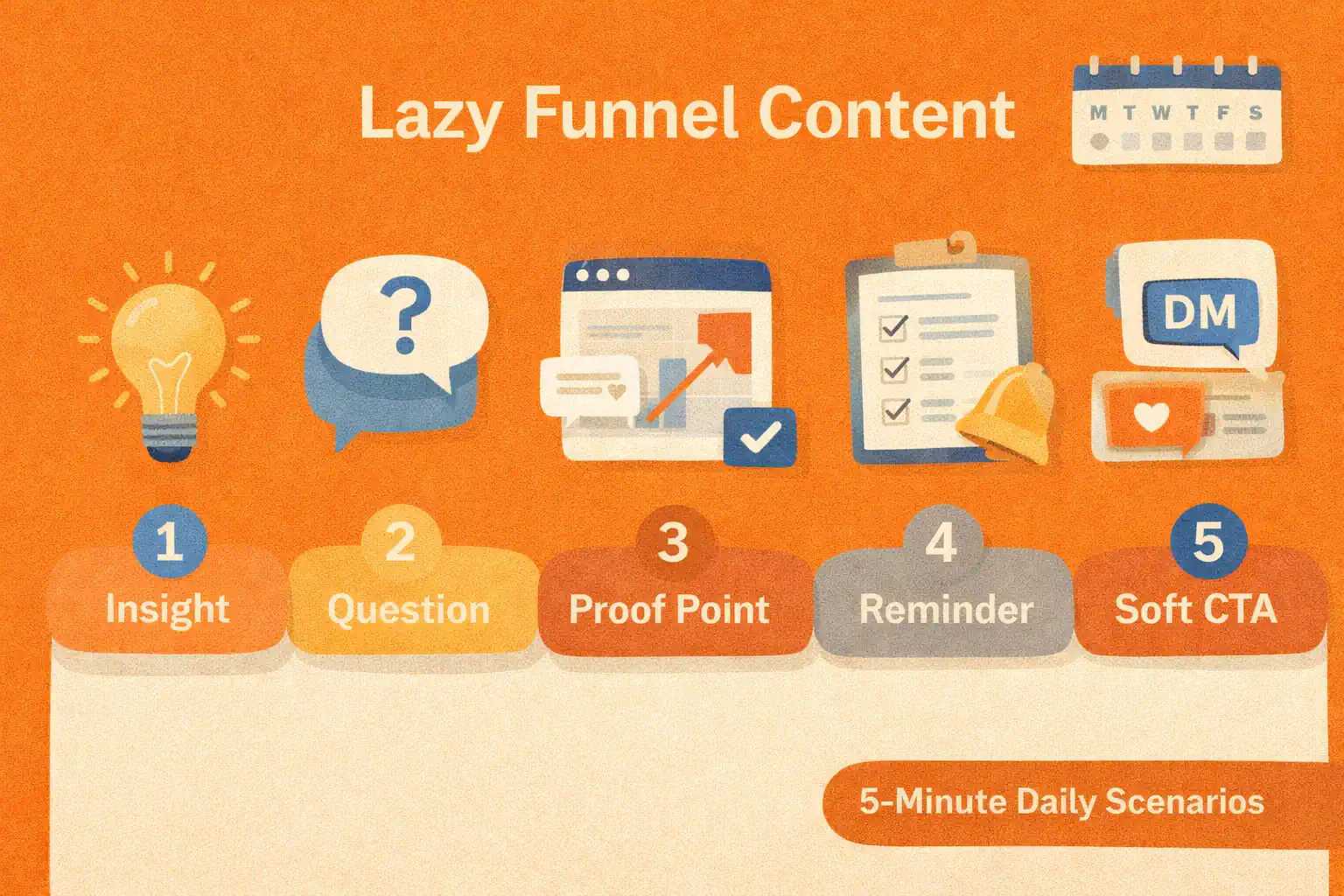
Not every business needs a complex funnel with dozens of assets, landing pages, and automated sequences. Many small teams need something simpler: a repeatable way to stay visible, build trust, and invite action without spending hours on content every day.
That is what a lightweight content funnel does. It uses small daily posts with clear roles. Some posts help new people understand the problem. Some build trust. Some show proof. Some invite a low-pressure next step.
This guide shows how to build a 5-minute daily content rhythm that supports a real funnel without becoming a heavy production system.
For broader planning, see the weekly social media calendar and the social media batching workflow.
What is a lightweight content funnel?
A lightweight content funnel is a simple sequence of recurring posts that move people from awareness to trust to action.
It is not lazy in quality. It is low-friction in execution.
Instead of building everything from scratch each day, you use repeatable scenarios such as:
- Answer one customer question
- Share one mistake to avoid
- Show one proof point
- Explain one small process
- Give one behind-the-scenes detail
- Invite one simple action
The key is that every post has a job.
The five funnel roles
A useful social media funnel needs more than promotional posts.
| Funnel role | What it does | Example post |
|---|---|---|
| Awareness | Names the problem | ”Why your content calendar keeps slipping” |
| Education | Teaches a useful idea | ”A 3-step way to plan next week’s posts” |
| Trust | Shows proof or process | ”How we review a post before scheduling” |
| Objection handling | Reduces hesitation | ”You do not need to post on every platform daily” |
| Action | Invites the next step | ”Try planning one week in a visual calendar” |
A lightweight funnel rotates these roles so your audience is not seeing the same CTA every day.
The 5-minute daily scenario library
Here are practical post scenarios you can create quickly.
1. The one-question answer
Pick a real customer or audience question and answer it in a short post.
Example: “How often should a local business post on Facebook? Start with 2 to 4 useful posts per week, then test based on calls, messages, and engagement.”
2. The quick checklist
Give the audience a small set of steps.
Example: “Before publishing a launch post: check the date, CTA, link, image crop, and platform formatting.”
3. The mistake and fix
Name one common mistake and one practical correction.
Example: “Mistake: using the same caption across every platform. Fix: keep the main idea, but change the hook and CTA for each audience.”
4. The tiny proof post
Share a process, example, testimonial, or before-and-after lesson.
Example: “A client had 30 ideas but no schedule. We grouped them into 4 pillars and planned the first 2 weeks before writing any captions.”
5. The behind-the-scenes note
Show how the work happens.
Example: “Today’s content planning rule: no post enters the calendar without a goal, platform, and owner.”
6. The soft CTA
Invite a small action that matches the post.
Example: “Save this for your next planning session” or “Try this checklist before scheduling your next batch.”
7. The reminder
Repeat an important point in a fresh way.
Example: “Consistency does not mean daily posting. It means your audience hears from you often enough to remember why you matter.”
Build a weekly lightweight funnel
Use this simple weekly rhythm.
| Day | Funnel role | 5-minute post idea |
|---|---|---|
| Monday | Awareness | Name one problem your audience is facing |
| Tuesday | Education | Share one checklist, tip, or framework |
| Wednesday | Trust | Show one example, process, or proof point |
| Thursday | Objection handling | Answer one hesitation or misconception |
| Friday | Action | Invite a small next step |
This rhythm works because it is balanced. You are not asking people to act before they understand the problem or trust your point of view.
Use prompts that do not sound generic
Weak prompt:
- “Post a tip.”
Better prompts:
- “What did a customer misunderstand this week?”
- “What step do people skip before they get stuck?”
- “What would make this decision easier for a beginner?”
- “What proof would reduce doubt?”
- “What is one thing we repeat on sales calls?”
- “What do people need to know before buying?”
Specific prompts create more useful posts.
Make the funnel platform-specific
The same funnel role can look different by platform.
Example topic: “Planning social media posts in advance.”
- LinkedIn: a short opinion about why planning reduces approval chaos
- Instagram: a carousel with a weekly planning checklist
- Facebook: a community-style post asking what blocks consistency
- Google Business Profile: a local update scheduled before a seasonal offer
- TikTok or YouTube Shorts: a quick screen recording of the planning process
- Telegram: a longer checklist saved for later
Postoria can help you plan these variations in one calendar so the funnel feels connected without copying the exact same post everywhere.
Avoid the most common lightweight funnel mistakes
Mistake 1: Every post sells
A funnel needs trust and education. If every post asks for action, the audience may tune out.
Mistake 2: No clear next step
Helpful content is good, but a funnel also needs a path. Add soft CTAs when relevant.
Mistake 3: Random topics
A 5-minute post should still connect to a weekly theme or content pillar.
Mistake 4: No review
If you never review saves, comments, clicks, or messages, the funnel cannot improve.
Mistake 5: Too many platforms at once
Start with one or two platforms. Add more only when the rhythm is sustainable.
A 20-minute weekly setup
Use this routine once per week.
- Choose one theme.
- Pick one audience problem.
- Write five post ideas using the funnel roles.
- Add one proof point or example.
- Choose one soft CTA.
- Schedule the posts.
- Review last week’s strongest signal.
A social media tool does not make the content useful by itself, but it removes friction from the publishing process. In Postoria, you can schedule the week, reuse media, and keep the posts organized by platform and workspace.
Conclusion
A lightweight content funnel is not about doing the least possible. It is about removing unnecessary complexity so useful content can happen consistently.
Start with five daily roles: awareness, education, trust, objection handling, and action. Use real customer questions and small examples. Keep the CTA soft and relevant. Over time, this simple rhythm can build visibility, trust, and qualified demand without burning out your team.