Instagram SEO checklist for brands: profile, captions, alt text, and topics
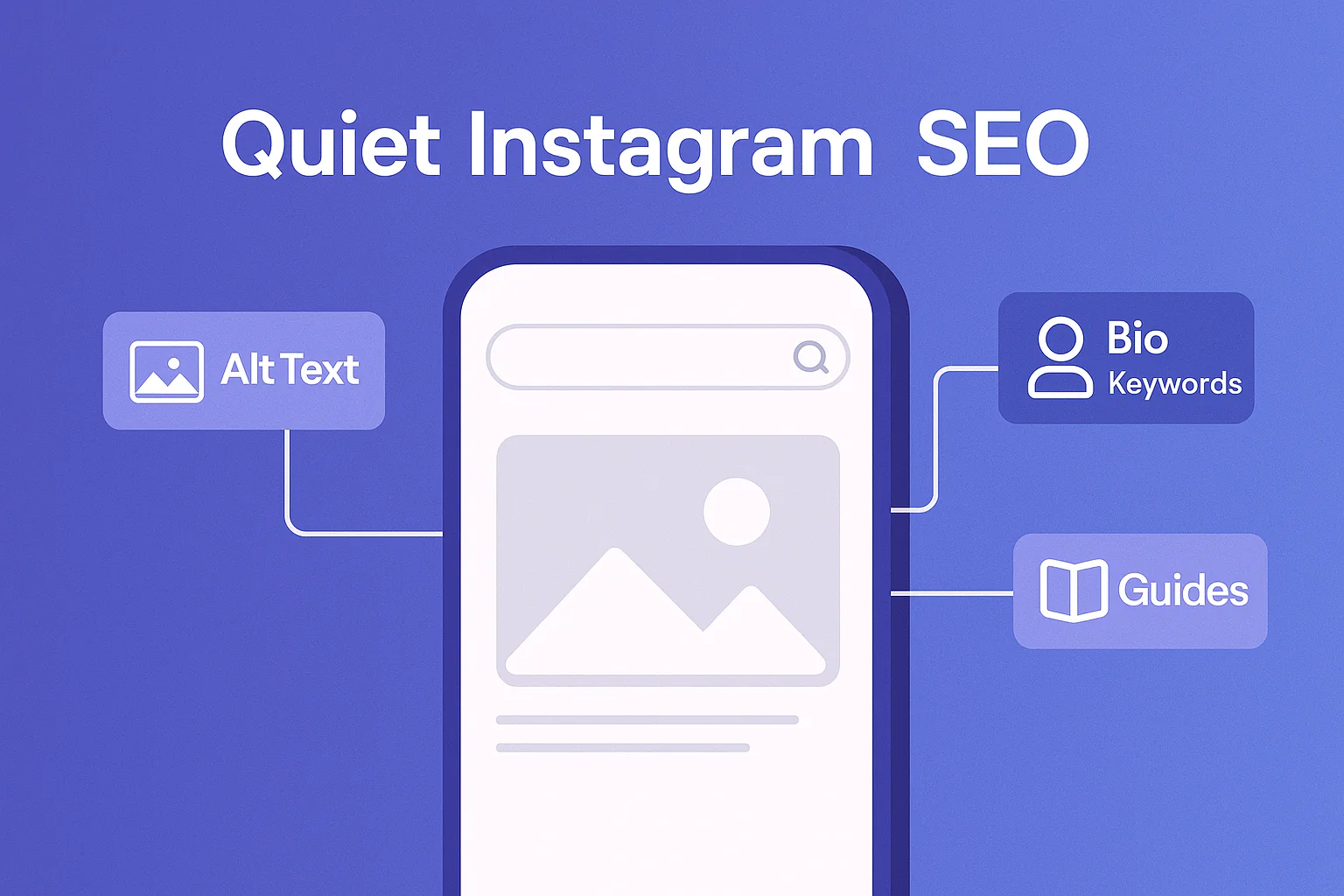
Instagram SEO is the practice of making your profile and content easier to understand, categorize, and discover. It is not about stuffing captions with keywords or hiding a wall of hashtags at the end of every post. It is about clarity.
A useful Instagram SEO workflow helps three groups at once:
- People searching for a topic, product, service, or local business
- Instagram systems trying to understand what your account is about
- Your own team trying to publish content around consistent themes
Instagram has explained that ranking uses many signals across different surfaces, including information about the post, the person who posted, and the viewer’s behavior. You can read Instagram’s official overview here: Instagram ranking explained. For brands, the practical takeaway is simple: make your content easier to understand and more useful to the audience it is meant for.
Start with a keyword map
Before editing your profile, create a small keyword map. This prevents your Instagram SEO work from becoming random.
Use four groups:
| Keyword group | What it means | Example for a local bakery |
|---|---|---|
| Core category | What you are | Bakery, custom cakes, pastries |
| Audience intent | What people need | Birthday cake, wedding dessert, corporate catering |
| Location | Where you serve | Chicago bakery, Lincoln Park cakes |
| Content themes | What you teach or show | Cake design, behind the scenes, ordering tips |
You do not need hundreds of keywords. Start with 10 to 20 phrases your audience might actually use.
Optimize your profile for clear discovery
Your profile should quickly answer three questions:
- What do you do?
- Who is it for?
- Where or how can people take the next step?
Handle
Keep your handle simple, recognizable, and close to your brand name. Avoid unnecessary punctuation if it makes the account harder to search or remember.
Name field
The name field is valuable because it can clarify your category. A brand name alone may not be enough.
Examples:
- “North & Pine Bakery”
- “North & Pine | Chicago Bakery”
- “Maya Chen | Brand Photographer”
- “Postoria | Social Media Scheduler”
Do not force keywords awkwardly. Add the clearest category phrase if it helps a real person understand you faster.
Bio
A good bio should include:
- Your audience or category
- Your main benefit
- A proof point or differentiator if available
- A clear next step
Weak bio:
Helping businesses grow online.
Stronger bio:
Social media scheduling for creators, small businesses, and agencies. Plan posts, manage calendars, and publish across platforms from one dashboard.
The stronger version is specific. It tells people and platforms what the account is about.
Write captions that name the topic early
Captions are not only for personality. They help frame the content.
A good SEO-friendly caption usually includes:
- The topic in the first line or early context
- Natural language your audience would use
- Specific examples instead of vague advice
- A CTA that matches the post goal
Weak opener:
This one is important.
Stronger opener:
If your Instagram posts get reach but no profile visits, your content may be missing a clear next step.
The stronger opener names the topic, problem, and audience intent.
Use alt text for accessibility first
Alt text should describe the image for people using screen readers. It can also help reinforce the topic of the post, but accessibility should come first.
Good alt text is:
- Specific
- Plain-language
- Accurate
- Not stuffed with keywords
Example for a carousel cover:
Carousel cover that says “5 local SEO post ideas for restaurants” with a photo of a restaurant table and a simple checklist layout.
Bad alt text:
Instagram SEO social media marketing restaurant marketing local SEO best restaurant tips viral growth.
The good version helps people understand the image. The bad version is keyword stuffing.
Build topic clusters instead of isolated posts
One post rarely creates strong discovery on its own. A cluster of related posts makes your account easier to understand.
Example cluster for a social media tool:
- How to build a weekly social media calendar
- How to schedule posts without losing brand voice
- How to use analytics to find your best posting times
- How to bulk upload posts from a spreadsheet
- How to post across multiple social platforms
That cluster tells a clear story: the account helps people plan, schedule, publish, and improve social media content.
If you need help turning topics into a repeatable system, start with a weekly social media calendar and connect it to a broader social media operating system.
Add location signals when local intent matters
Location matters for restaurants, salons, real estate agents, gyms, clinics, shops, events, and service businesses.
Useful location signals include:
- City or neighborhood in the bio where appropriate
- Location tags on relevant posts
- Local words in captions when natural
- Photos that clearly show the place, service area, or event
- Google Business Profile posts that support local discovery
For local businesses, Instagram and Google Business Profile should work together. A post can build trust visually on Instagram while a Google Business Profile update supports people searching in Maps or Search. Read more in our guide to Google Business Profile vs. social media.
Use hashtags as context, not a crutch
Hashtags can still help categorize content, but they should not carry the whole SEO strategy.
A practical hashtag set can include:
- 1 to 3 category hashtags
- 1 to 3 niche or audience hashtags
- 1 to 3 location hashtags if relevant
- 1 branded hashtag if it is actually used
Avoid using the same generic set on every post. A caption about restaurant menu photography should not use the same tags as a post about hiring staff or announcing a new location.
Make Reels searchable with speech and on-screen text
Instagram does not only read the caption. For Reels, the topic should be clear in the video itself.
Use:
- Spoken keywords in natural language
- On-screen titles that name the topic
- Captions that summarize the value
- Covers that clearly label the idea
- Series names for repeatable formats
Example:
Instead of opening with:
“You need to hear this.”
Try:
“Three Instagram content ideas for local service businesses.”
The second version is clearer for both viewers and discovery.
Review search performance monthly
Instagram SEO improves through iteration. Once a month, review:
- Which posts brought profile visits?
- Which topics earned saves or shares?
- Which captions created qualified comments?
- Which Reels kept viewers watching?
- Which posts led to website clicks or inquiries?
- Which keywords or topics deserve a follow-up?
If you manage content across several platforms, Postoria can help you keep the planning and review process in one place. You can schedule content, organize campaigns in a visual calendar, and use analytics to decide which topics should appear again.
Instagram SEO checklist
Use this before publishing a post:
- Is the topic clear in the first line or first frame?
- Does the caption use natural audience language?
- Is the post part of a topic cluster?
- Does the visual or Reel cover identify the subject?
- Is alt text descriptive and accessible?
- Are hashtags specific to this post?
- Are location signals included if local intent matters?
- Is the CTA matched to the search intent?
- Will this post help the right person understand the account better?
Conclusion
Instagram SEO is not a hack. It is a clarity system. Your profile, captions, alt text, topics, location signals, and video packaging should all make it easier for the right audience to find and understand your brand.
Start small. Build a keyword map, update your profile, write clearer captions, describe images accurately, create topic clusters, and review what actually brings useful actions. Over time, that clarity helps your content become easier to discover and easier to trust.