TikTok Spark Ads vs. standard ads: a practical decision guide
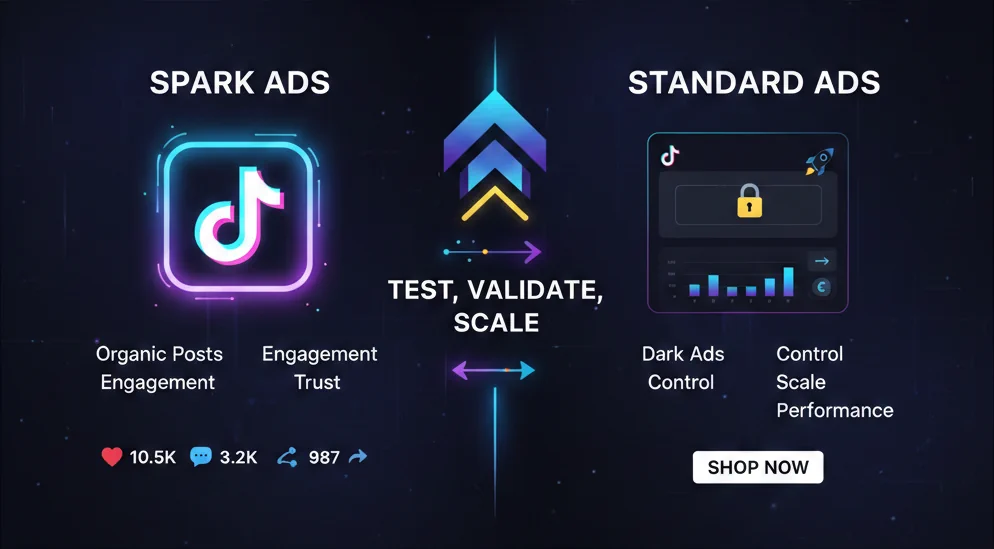
TikTok Spark Ads and standard TikTok ads can look similar in a campaign plan, but they solve different problems.
Spark Ads promote existing organic posts from your brand account or from creators who authorize the post for advertising. Standard ads are built inside the ad system and do not need to appear as organic posts first.
Choosing between them is not just a media-buying decision. It affects your creative workflow, creator agreements, content testing, social proof, and how your organic TikTok presence grows over time.
This guide explains when to use Spark Ads, when to use standard ads, and how to build a simple testing workflow that does not confuse engagement with business impact.
The simple difference
According to TikTok’s own Spark Ads documentation, Spark Ads let advertisers use organic TikTok posts in advertising, including posts from their own accounts or from creators with authorization. Engagement from the ad can be attributed to the original organic post.
That makes Spark Ads useful when the post already feels native and has signs of audience interest.
Standard ads are different. They are paid creatives built for ad delivery. They can be faster to iterate, easier to control, and cleaner for direct-response testing because they do not depend on an existing organic post.
Quick decision table
| Situation | Better starting point | Why |
|---|---|---|
| You have a creator video that already gets strong comments | Spark Ads | The creative has social context and proof built in |
| You need to test five hooks quickly | Standard ads | You have more control over variations |
| You want to grow engagement on a brand post | Spark Ads | Paid activity can support the original post |
| You need strict offer, landing page, and CTA control | Standard ads | The campaign can be built around conversion testing |
| You are launching with no proven organic creative | Standard ads first | You need to discover what works before amplifying it |
| You are turning UGC into a paid campaign | Spark Ads | The format keeps the creator context visible |
The strongest teams often use both. Standard ads help test controlled variables. Spark Ads help amplify content that already feels native.
When Spark Ads make more sense
Spark Ads are strongest when the creative depends on authenticity, social proof, or creator context.
Use Spark Ads when:
- A creator post explains the product better than your brand account can.
- The comment section adds useful proof or objections.
- The product needs trust before the click.
- You want paid spend to support an organic post instead of running separate dark ads.
- The creative already has a hook, pacing, and tone that fit TikTok.
Good Spark Ad candidates include:
- Product demos from real users
- Creator tutorials
- Before-and-after explanations where the claim is realistic
- Customer-style problem videos
- Founder or expert posts that already earned thoughtful comments
Spark Ads are not a shortcut for weak content. If the organic post has a confusing hook, poor retention, or unclear product fit, boosting it will usually magnify those problems.
When standard ads make more sense
Standard ads are better when control matters more than organic context.
Use standard ads when:
- You need to test multiple hooks, offers, or landing pages.
- The ad needs a very specific CTA.
- You want to isolate one variable at a time.
- You are retargeting a warm audience with a direct offer.
- The creative includes claims, disclaimers, or edits that need brand review.
Standard ads are also useful early in a campaign when you do not yet know which message works. You can test several angles, identify winners, and then turn the best organic or creator versions into Spark Ads later.
If you need more testing ideas, the framework in A/B testing auto posts can help you think through variables like hook, timing, format, and CTA.
Do not use the same KPI for both formats
A common mistake is judging Spark Ads and standard ads by the same metric too early.
Spark Ads often need a mixed scorecard because they can influence both paid performance and organic trust.
Useful Spark Ad KPIs:
- View-through behavior
- Watch time and completion quality
- Comments that show purchase intent
- Profile visits
- Follows
- Saves and shares
- Landing page clicks
- Assisted conversions if you track them
Useful standard ad KPIs:
- Cost per click
- Landing page conversion rate
- Cost per lead or purchase
- Offer response
- Frequency
- Creative fatigue
- Return on ad spend where attribution is reliable
For attribution, keep your tracking consistent. The article on UTM tags and social media attribution explains how to avoid mixing channels, campaigns, and creative names in ways that make reporting harder later.
A practical testing workflow
Use this workflow if you are deciding between Spark Ads and standard ads for a new product, offer, or creator campaign.
Step 1: Publish organic creative first when possible
Start with a small batch of organic TikTok posts around different angles:
- Problem and pain point
- Tutorial or how-to
- Product comparison
- Founder explanation
- Customer-style objection handling
- Short proof or demonstration
Postoria can help you plan these organic tests in a visual calendar and coordinate related posts across TikTok, Instagram, YouTube, LinkedIn, and other supported platforms. If you want a broader cross-platform workflow, see post across social media.
Step 2: Identify the strongest organic signals
Do not choose a Spark Ad candidate only because it has the most views. Look for signs that people understood the point and cared enough to act.
Prioritize posts with:
- Strong retention relative to your own account baseline
- Comments that ask practical buying questions
- Saves or shares
- Profile visits
- Clicks if the post includes a link path
- Clear hook-message fit
If a post gets attention for the wrong reason, do not spark it. Paid spend should amplify the message you want to own.
Step 3: Use Spark Ads for proof and standard ads for scale tests
Once you have a winner, split the next phase by job:
- Spark Ads: amplify creator context, proof, and native engagement.
- Standard ads: test offers, landing pages, and conversion angles.
This prevents a common mistake: forcing Spark Ads to do every job at once. A creator video may be excellent for trust but weak for a hard discount offer. A standard ad may convert better but do little for organic brand lift.
Step 4: Review comments as creative research
TikTok comments are not just engagement. They are message research.
Look for:
- Questions people repeat
- Misunderstandings about the product
- Price sensitivity
- Feature requests
- Comparisons to alternatives
- Language you should use in future hooks
Turn those comments into new organic posts, FAQs, and retargeting creatives. A strong TikTok ad system keeps feeding the content calendar.
Common mistakes to avoid
Avoid these problems when comparing Spark Ads and standard ads:
- Boosting a creator post without clear usage rights and authorization
- Choosing Spark Ads only because the post looks authentic
- Using standard ads that feel too polished for TikTok
- Testing too many variables at once
- Judging creator content only by last-click revenue
- Ignoring comments because they are harder to quantify
- Scaling before you know which audience or offer actually worked
How Postoria fits the workflow
Postoria is not an ad buying platform, but it helps with the organic side that makes better paid tests possible.
You can use Postoria to:
- Plan TikTok posts and related content in one calendar
- Keep a steady publishing cadence before a paid test
- Reuse winning ideas across Instagram, YouTube Shorts, LinkedIn, and more
- Organize media assets for creator or product campaigns
- Review social performance alongside your publishing plan
If your team is trying to test content before spending more on ads, a consistent scheduling system helps you separate weak creative from inconsistent execution.
Conclusion
TikTok Spark Ads and standard ads are not competitors. They are different tools.
Use Spark Ads when organic context, creator trust, and social proof matter. Use standard ads when you need control, fast iteration, and cleaner direct-response testing. Then connect both with a repeatable content workflow: publish, learn, amplify, test, and improve.
The best choice is the one that matches the job of the campaign, not the one that sounds more advanced.