Social media lead magnets people actually finish: mini-courses, challenges, and practical sequences
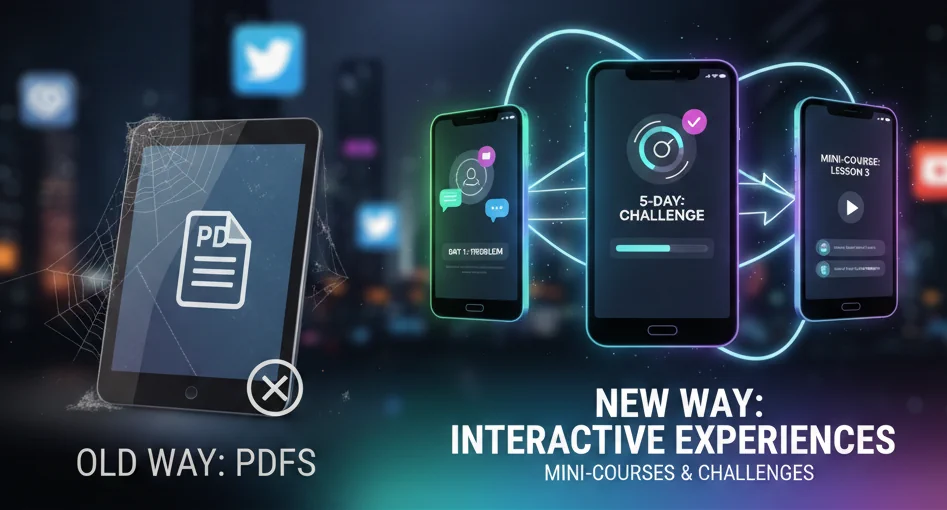
A PDF can still be a good lead magnet. The problem is that many PDFs are downloaded, saved, and never opened.
For social media, a stronger option is often a lead magnet that unfolds over time: a short mini-course, a 5-day challenge, a guided content sprint, a private sequence, or a public series with a clear next step.
These formats work because they give people small wins before you ask for a bigger commitment. They also create more useful signals than a single download. You can see who replies, completes tasks, asks questions, clicks, saves, or comes back for the next lesson.
This guide shows how to design social media lead magnets that people actually finish.
Start with the finish line
A weak lead magnet starts with the asset format.
“Let’s make a PDF.”
A stronger lead magnet starts with the outcome.
“What should a good-fit prospect be able to do, understand, or decide after this experience?”
Before choosing a format, answer five questions:
- What problem does the audience want solved soon?
- What result can you help them get in less than 10 minutes per day?
- What action proves they are more serious than a casual viewer?
- What objection should they understand before buying?
- What next step should feel natural after the lead magnet ends?
When the finish line is clear, the format becomes easier to choose.
Choose the right lead magnet format
Not every offer needs a challenge. Not every topic needs a course. Use the format that matches the audience’s problem and commitment level.
| Format | Best for | Commitment level | Example |
|---|---|---|---|
| 3-day mini-course | Teaching a simple framework | Medium | ”Plan your first LinkedIn content system” |
| 5-day challenge | Building action and momentum | Medium to high | ”Publish one useful post per day for a week” |
| Public content series | Growing awareness before opt-in | Low | ”7 mistakes that make product pages hard to trust” |
| Private group sprint | Community, accountability, feedback | High | ”Fix your Instagram profile in 5 days” |
| Email plus social reminders | Education with clear follow-up | Medium | ”One lesson by email, one reminder on social” |
| Interactive checklist | Quick qualification and segmentation | Low to medium | ”Audit your social calendar in 15 minutes” |
The best format is the one your team can deliver consistently without overcomplicating production.
The FINISH framework
Use this framework to make a lead magnet more useful and less like generic gated content.
F: Focus on one narrow outcome
Do not promise a complete transformation in five days. Choose one visible win.
Weak promise:
“Become a better marketer.”
Better promise:
“Build a one-week content calendar for your service business.”
I: Include one action per lesson
Each day should have one clear task. If people need to watch three videos, read a guide, fill out a workbook, and join a call, completion will drop.
A good daily task is specific:
- Rewrite your profile headline.
- Record one 30-second product demo.
- List five customer questions.
- Turn one FAQ into a carousel outline.
N: Nudge people at the right time
Social lead magnets need reminders. People are busy, and social platforms move fast.
Plan reminders before the sequence starts:
- Launch announcement
- Day 1 welcome
- Daily task reminder
- Midpoint encouragement
- Final-day recap
- Follow-up CTA
Postoria can help you schedule these reminders across supported platforms from one calendar, so the sequence does not depend on manual posting every morning.
I: Invite replies and proof of progress
A lead magnet becomes more valuable when participants can respond.
Ask for lightweight proof:
- Comment “done” after completing the task.
- Reply with one sentence.
- Share a screenshot.
- Vote in a poll.
- Submit one question for the final recap.
These signals help you understand who is engaged and what content to create next.
S: Segment based on behavior
Do not treat every participant the same after the sequence.
Segment people by what they did:
- Joined but did not participate
- Completed one task
- Completed most tasks
- Asked a buying question
- Clicked the offer page
- Shared their work publicly
Each group needs a different follow-up. Someone who completed every task may be ready for a product trial, consultation, or paid offer. Someone who joined but did not act may need a simpler recap.
H: Hand off to the next logical step
The final CTA should feel like the next step, not a hard turn.
Examples:
- “If you built the calendar, try scheduling the first week.”
- “If you finished the audit, use the template to fix the top three issues.”
- “If you want feedback, book a review session.”
- “If your team needs to run this monthly, set up the workflow in Postoria.”
Example 1: 5-day content calendar challenge
This works well for creators, consultants, and small businesses that struggle with consistency.
Day 1: Pick one audience and one content goal.
Day 2: Choose three content pillars.
Day 3: Turn customer questions into post ideas.
Day 4: Draft five captions or outlines.
Day 5: Schedule the first week and write a review reminder.
The natural CTA is to schedule the posts, review performance, and repeat the workflow next week. You can connect this to a guide like how to build a weekly social media calendar for readers who want the full planning process.
Example 2: 3-day product education mini-course
This works well for e-commerce, SaaS, and service businesses where buyers need to understand the product before they convert.
Day 1: Explain the problem and why common solutions fail.
Day 2: Show the decision criteria buyers should use.
Day 3: Demonstrate how your product or service fits the criteria.
The CTA can be a comparison page, a demo, a trial, or a product guide. The key is that the CTA continues the education rather than interrupting it.
Example 3: 7-day creator launch warm-up
This works well for templates, courses, memberships, digital products, and coaching offers.
Day 1: Share the problem story.
Day 2: Teach one small method.
Day 3: Show a behind-the-scenes example.
Day 4: Answer a common objection.
Day 5: Share proof or a mini case study.
Day 6: Invite questions.
Day 7: Open the offer with a clear explanation of who it is for.
This format works because the sales message is earned through useful content.
How to promote the lead magnet without sounding repetitive
Promote the same lead magnet from several angles instead of reposting the same announcement.
Try these angles:
- The pain point: “Still planning content every morning?”
- The outcome: “Build next week’s calendar in 5 days.”
- The proof of work: “Here is what Day 2 looks like.”
- The objection: “You do not need a 30-day plan to start.”
- The deadline: “The challenge starts Monday.”
- The recap: “Missed it? Here are the five lessons.”
If you need a larger list of reusable prompts, see 20 content ideas to automate your social media posting.
Where Postoria fits
Postoria is useful when your lead magnet has multiple moving parts:
- Announcement posts
- Daily reminders
- Platform-specific variations
- Short videos or carousels
- Recap posts
- Follow-up CTAs
- Client or team approvals
You can plan the sequence in a visual calendar, reuse media assets, coordinate multiple workspaces, and publish across supported platforms. Paid plans also include AI captions and automations, which can help speed up variations and recurring reminders when the workflow is already clear.
Common mistakes to avoid
Avoid these traps:
- Making the lead magnet too long
- Teaching too much before people get a win
- Asking for a big CTA on Day 1
- Sending the same reminder every day
- Forgetting to segment participants after the sequence
- Building a challenge your team cannot run again
- Measuring only signups instead of completion and next-step behavior
A lead magnet is not successful because many people joined. It is successful when the right people make progress and know what to do next.
Conclusion
The best social media lead magnets are not just files. They are guided experiences.
Use mini-courses when people need understanding. Use challenges when they need momentum. Use public series when the audience is still cold. Keep the promise narrow, make each task easy to finish, and connect the final step to the problem you just helped solve.
When a lead magnet helps people complete something useful, conversion becomes a continuation of trust rather than a sudden sales pitch.